On People, Ideas, and Crossings

Foreword to Black Atlantic Crossings, by Sabrina Gledhill (forthcoming)
In recent decades, social scientists have been studying connections, links and dialogues involving intersecting ideas, people and circuits. Transnational perceptions of intercultural movements have been revealed. At different times and in different spaces, from the fifteenth century to the first half of the twentieth, the populations of diasporic societies and their social, political and economic structures were linked in the four corners of the Atlantic. Using pieces of what was invented as Europe and designed as Africa, the parts called Cuba, Brazil, Jamaica, Puerto Rico, Colombia, Haiti, Martinique, Mexico, Guadeloupe, the USA, Barbados and others were linked together and redefined. Fundamentally, experiences and people produced events that were transformed into narratives.

Above all, intellectual constructs and the elaboration of ideas were processed in different contexts, reconnecting different projects and expectations. We can see the emergence of ideas around modernity and liberalism, engaging in dialogue with racism, forced labour, exclusion, and vectors of citizenship under construction.

In this complex process, we can think about intellectual roots, their agents, and the circulation of ideas, reframing ideologies and bringing together colonial, slavocratic, post-colonial and post-emancipation societies.

Today, however, it is the people involved in these processes who are mobilizing scholars and research the most. How did ideas circulate? What were the vectors? And what were the levels of reception, transformation and influence? We still need to take a careful look at the literate circulation and oral unfolding of Atlantic ideas. Books and translations came into people’s hands. International news abounded in the nineteenth-century press. Since the 1830s, debates on emancipation in the British Caribbean and its consequences were closely followed, gaining shape in the mid-nineteenth century in the French and Dutch Caribbean, Spanish America and, after the US Civil War, Puerto Rico, and Cuba.

How did Black intellectuals—albeit immersed in slavocratic societies— interpret and re-elaborate these processes? Not just by receiving ideas, but by producing and circulating them in an elaborated way. Sabrina Gledhill’s research, presented in this book, opens paths for us to get to know this adventure of ideas and its Black Diaspora characters. It begins with Manuel Querino, an outstanding intellectual and working-class leader at the turn of the twentieth century. Born on the fringes of the Bahian hinterland, amid slavery and the cholera epidemic that made him an orphan, Querino crossed some boundaries of exclusion. He learned to read and write at a very young age. This guaranteed him a brief military career as a clerk during the Triple Alliance War (1865-70). Still pursuing his studies, he entered the School of Fine Arts, studying geometric design, architecture, and later working as a teacher at the Liceu de Artes e Ofícios (School of Arts and Crafts) and the Colégio dos Órfãos de São Joaquim (St. Joachim Orphans’ College) in the city of Salvador. In the 1870s and 1880s, he was active in the abolitionist movement, joining anti-slavery societies and founding at least two newspapers. His political life was extended at the end of the century when he joined the Workers’ Party. He produced technical writings on geometric drawing and the arts, as well as humanist essays on Africans and the Black presence in Bahia.

Some of the highlights of Querino’s life and work, which are explored in Gledhill’s study, are precisely the Afro-Atlantic dimensions of his thinking, particularly his dialogues and interlocution with the ideas of Booker T. Washington (1856-1915). Thus, this is both a biography and an intellectual history with an Atlantic perspective. Receptions, appropriations, translations and resignifications reveal different roots of the Brazilian social thinking that was emerging in the first decades of the twentieth century. Urban development, exclusion, access to education, trade unions, elections, political parties, African scenarios and debates on race and colonization are the subjects of intersecting elaboration and dialogue that this pan-Africanist Bahian intellectual established.

However, we also need to know more about the intellectual landscapes framed by Querino. We will certainly find generations of Black intellectuals and literati who tried to turn skills, education and expectations of mobility into weapons in a society that was still aristocratic in Bahia, amid tremendous arrogance due to the social invisibility and economic exclusion of the Black population. More than learning about his life and chapters of tremendous personal determination, it is essential to read Querino himself. The subjects he analysed and the intellectual worlds he expanded demonstrate the Black social thinking that was made invisible at the dawn of the twentieth century. We know that these processes of intellectual erasure were recurrent. It is not a matter of being absent, non-existent or invisible. Silencings have been verified. But not just that. We have identified other Black Diaspora thinkers among Querino’s interlocutors. Not just Du Bois or Marcus Garvey, and even other non-Americans with the same origins. In Brazil, we know very little about the activities and legacy of Booker T. Washington. Why is that? On what basis did Querino establish the dialogue? What were the universes of the influences he saw? Making these connections and dialogues emerge takes us on an Atlantic voyage to the intersecting circuits of ideas and people. It is important to use stronger lenses in our observations. Querino and his work were guided by religious expressions with African roots, political parties, elections, representations, workers’ conferences and intellectual affirmation.

More than pointing out the shores of the Black Atlantic from analytical ships on calm seas, we must disembark, locating unstable and improvised territories. This study not only offers a safe haven, but, above all, charts the way forward.

Flavio dos Santos Gomes

Flavio Gomes is a Brazilian historian and author. His writings include books and articles on maroons published in Portuguese, English, French, and Spanish. The winner of the prestigious Jabuti Prize and a Guggenheim Fellow, he has been a professor of History at the Universidade Federal do Rio de Janeiro (UFRJ) since 1998.

Exciting new titles are coming this year

Black Atlantic Crossings: Discover the ground-breaking anti-racist strategies of Booker T. Washington and Manuel R. Querino in this insightful translation and adaptation. Explore the transatlantic exchange of ideas that shaped Black activism in the early 20th century.

Dance of the Serpent: Delve into the captivating life story of capoeira mestre Cobra Mansa. From his early days in Brazil to his international influence, this biography traces his journey as a martial artist, teacher, and cultural ambassador.

Stay tuned for release dates and pre-order information!

Black History Month in the USA – 2025

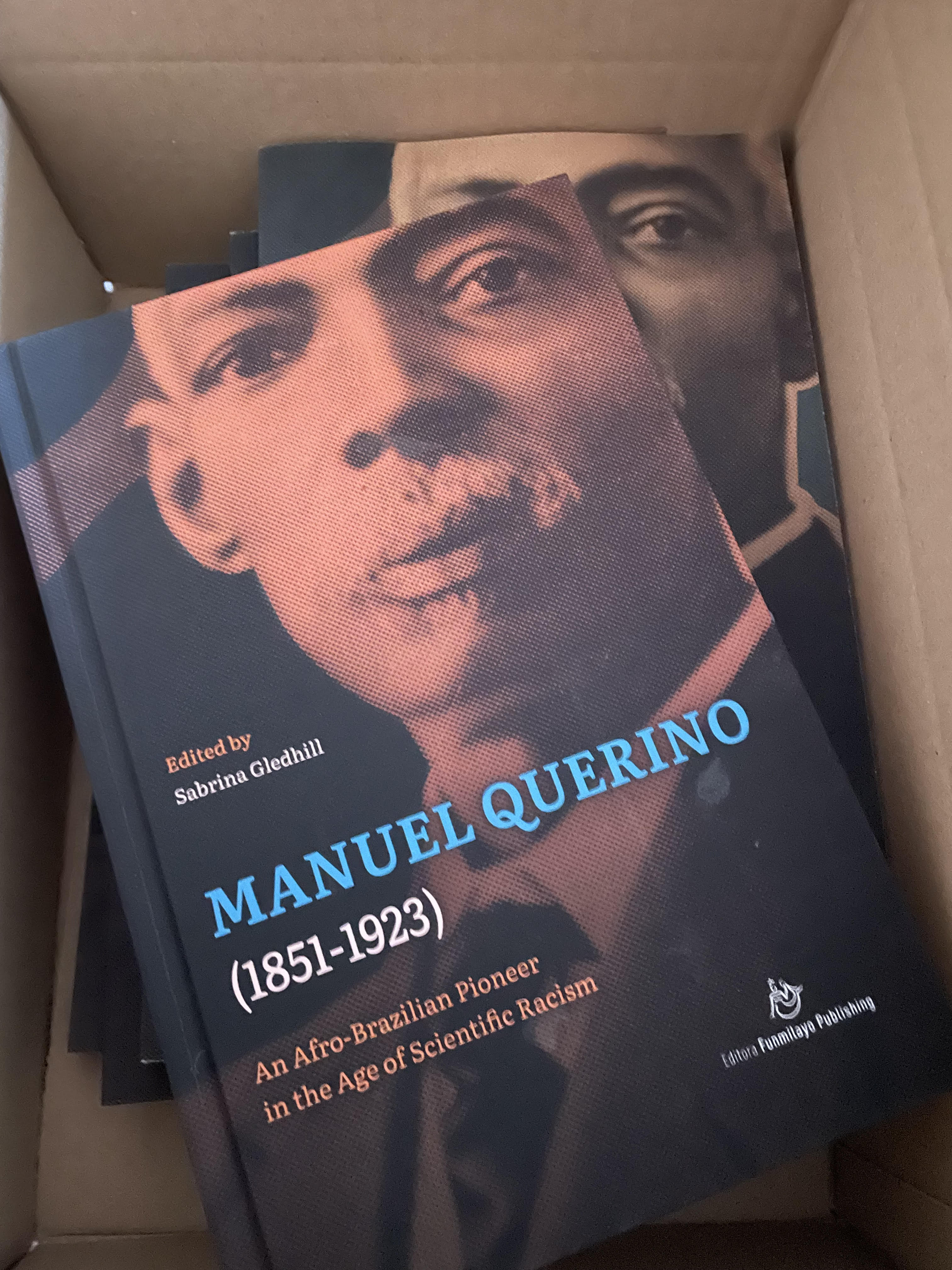
Black history isn’t confined to a single month—it’s a living, breathing tapestry woven into the fabric of our world. At Funmilayo, we’re committed to sharing these vital stories every day of the year. But because it is officially Black History Month in the USA, we are celebrating with special ebook deals on our Unsung Heroes in Black History Series on Amazon.com: Heroes Sung and Unsung and Manuel Querino (1851-1923) are free, and The Need for Heroes is only $0.99. Discover the richness of Black history!

Resistance takes many forms – including books!

As white supremacy resurges and attempts to erase Black history intensify, our publications stand as an act of resistance. They showcase essays by Black intellectuals, demonstrating the enduring strength and resilience of Black people in the face of prejudice. Our books amplify Black voices from the US and Brazil, clearly showing that Africans and their descendants in the diaspora have always defied racist stereotypes. Ironically, even proponents of scientific racism acknowledged Black artistic talent–a rare point of agreement with the intellectuals whose work we champion.

Manuel Querino: A Legacy Rediscovered (Again and Again)

For decades, I’ve been fighting to bring Manuel Querino, a pioneering Afro-Brazilian scholar, out of the shadows. Last week, I found a new ally in that fight: a PhD student at the prestigious University of São Paulo (USP), who has made Querino the focus of his thesis. His name is Fernando Filho, he is a sociologist, and his approach to what I call “Querinology” is to answer three questions:

  • how can Querino’s theses contribute to Brazilian social thinking?
  • what led to his “invisibility” in social theory?
  • to what extent are the subjects Querino dealt with also addressed by renowned authors like Gilberto Freyre and Florestan Fernandes?

Speaking on Google Meet, we spent over an hour discussing our approaches to Querino. Fernando told me how he struggled to get his PhD accepted by a university – being turned down by more than one before getting accepted at USP. He also said that he has been speaking about Querino at conferences in several Latin American countries and finding that the Afro-Brazilian polymath is still a complete unknown there.

I shared some sources, including the collection of essays in Manuel Querino (1851-1923), and explained how I began researching his life and work – thanks to my MA supervisor at UCLA, the late great E. Bradford Burns. I also observed that when I first arrived in Brazil in 1986, Querino had been largely forgotten or, worse, dismissed as an unreliable source. It took years of effort and many publications to change that.

What I took away from our conversation was

(a) despite the fact that I and other scholars, including Jeferson Bacelar, Luiz Freire, Maria das Graças de Andrade Leal, and Jaime Nascimento, have been writing and lecturing about Querino for decades, he is still largely unknown in Brazil’s elite universities; and

(b) ensuring that his life and legacy are not forgotten is a generational task.

Clearly, there is still much work to be done in bringing Querino the recognition he deserves. But with passionate scholars like Fernando Filho taking up the mantle, I’m hopeful for the future of ‘Querinology.'”

A luta continua (the fight goes on).

Sabrina Gledhill

Descobrindo obras de Manuel Querino na biblioteca do Museu Imperial

Recentemente, o pesquisador e professor universitário Fabiano Cataldo encontrou vários livros e artigos da autoria de Manuel Querino na biblioteca do Museum Imperial no Rio de Janeiro e convidou Sabrina Gledhill a escrever um texto sobre eles. Esta semana, imagens dos livros e o texto foram postados no Instagram. Segue o link:

Today Is Black Consciousness Day in Brazil

20 November marks the anniversary of the assassination of Zumbi dos Palmares, the best-known leader of Brazil’s most famous and enduring quilombo. This maroon settlement was established in the mountains of what is now Pernambuco by enslaved people who self-emancipated by escaping bondage.

This year, we published an anthology entitled The Need for Heroes. It contains writings by Black intellectuals from the US and Brazil that celebrate the heroism of maroons and soldiers who fought for liberation. One of the authors is Manuel Querino, writing about Palmares over a century ago.

Imagined portrait of Zumbi dos Palmares

Joining Forces to Reverse Historical Erasure

Recently, Brazilian actress Tais Araújo posted a photograph of herself on Instagram, with a copy of Projeto Querino, by journalist Tiago Rogero. Earlier, on 31 October, Tiago published an article in The Guardian about his book, explaining how it developed from the Projeto Querino podcast, which, in turn, was inspired by the New York Times‘s 1619 Project. That article contained a link to this website, boosting its visitors considerably. According to Tiago:

“Projeto Querino is based on a journalistic project that involved a team of more than 40 people, over two years and seven months of work.
Inspired by the New York Times’ 1619 Project, it launched in 2022 as a podcast produced by Rádio Novelo and a series of magazine articles. Before joining the Guardian in April, I spent another year conducting further research and writing the book.
A central idea was to understand and illustrate how Black people participated in crucial moments of Brazilian history – such as independence in 1822 or the extensively delayed abolition of slavery in 1888 – something that some school curriculums and parts of the media refuse to acknowledge.
Its name is a tribute to Manuel Raimundo Querino (1851-1923), a groundbreaking Brazilian intellectual born free in Bahia state. He is considered the first person to portray Africans and Afro-descendants positively in the country’s historiography.”

‘We built Brazil’: how descendants of enslaved Africans have helped shape the country, by Tiago Rogero

Tiago Rogero and the historian Ynaê Lopes dos Santos interviewed Sabrina Gledhill about Manuel Querino for the podcast in 2021, and Projeto Querino was launched in 2022. Sabrina`s interview can be found in episode 4 (the link is to the PDF in English).

The next major project was Isis Gledhill’s bio-documentary on Querino, which was launched on YouTube in November 2023 and has already racked up over 8,500 views and been selected for screening at two Brazilian film festivals. Tiago and Ynaê gave interviews for the documentary, as did Sabrina and several other scholars who study Querino.

Someone asked if the Projeto Querino book was competing with Funmilayo’s anthology Manuel Querino (1851-1923): An Afro-Brazilian Pioneer in the Age of Scientific Racism. The answer is not at all. We are very pleased that the word is getting out there about Manuel Querino and his legacy. Tiago has used the platform of The Guardian to spread the word about his own book, while generously sharing a link that enables his readers to find out more about Querino through our publications. One of these days, our work will be done, but as long as the process of erasure continues, “a luta continua” (the fight goes on).