Black Atlantic Crossings: The Lives and Anti-Racist Tactics of Booker T. Washington and Manuel R. Querino

Black Atlantic Crossings by Sabrina Gledhill examines the lives and anti-racist tactics of Booker T. Washington and Manuel R. Querino, two influential figures in the Black Atlantic world whose contributions have often been overlooked or belittled. Challenging this historical erasure, the book argues that these figures were not merely products of their respective national contexts (the United States and Brazil) but rather transatlantic intellectuals who navigated and challenged the racialised boundaries of their time. It emphasises the interconnectedness of Black experiences and intellectual movements across the Atlantic, highlighting how Washington and Querino, despite their geographical distance, shared common concerns and engaged in vital transnational dialogues. Furthermore, it analyses the strategies and tactics they employed to combat racism and promote social justice within their societies, including their engagement with education, politics, and cultural production, ultimately offering a crucial rethinking of their lives, work, and enduring impact beyond narrow nationalistic frameworks.

The latest addition to Funmilayo’s Unsung Heroes series, Black Atlantic Crossings is now available in full-colour and black-and-white editions. You can find it on all major online booksellers, including Amazon and Waterstones.

Praise for Black Atlantic Crossings
As promised, Sabrina Gledhill’s research does, in fact, expand the Black Atlantic by putting into dialogue the ideas and activism of two giants of the African Diaspora in the Americas. The legacy of Booker T. Washington has been well known, including in Brazil, since the turn of the twentieth century. However, in addition to reinterpreting his legacy in a broader context, this book introduces the English-speaking reader to Manuel Querino, an insightful and multifaceted Afro-Brazilian thinker who is little known outside Brazil. Enjoy reading this original work, which is destined to become a classic.
João José Reis, Universidade Federal da Bahia, author of Slave Rebellion in Brazil

Black Atlantic Crossings is a timely reflection on the challenges that African American intellectuals faced in the aftermaths of slavery in Brazil and the United States. While not always understood or accepted by later commentators, the anti-racist activism of Manoel Raimundo Querino and Booker T. Washington, ably analyzed by Sabrina Gledhill, profoundly challenged the emerging post-slavery hierarchies. She demonstrates that there is much to learn from these two men’s lives and the evolution of their historical memory in the century since their deaths.
Hendrik Kraay, University of Calgary, author of Bahia’s Independence: Popular Politics and Patriotic Festival in Salvador, Brazil, 1824-1900

Crossing the Atlantic requires navigating a sea of stories through rough and calm waters, amidst fleeting encounters and enduring dialogues. In this insightful work, Sabrina Gledhill offers more than just a theoretical compass. Her sophisticated approach reveals the profound oceanic connections that shaped Booker T. Washington and Manuel R. Querino, revisiting them as original Atlantic characters, without borders, but with transnational margins.
Flavio dos Santos Gomes, Universidade Federal do Rio de Janeiro, co-author of The Story of Rufino: Slavery, Freedom, and Islam in the Black Atlantic
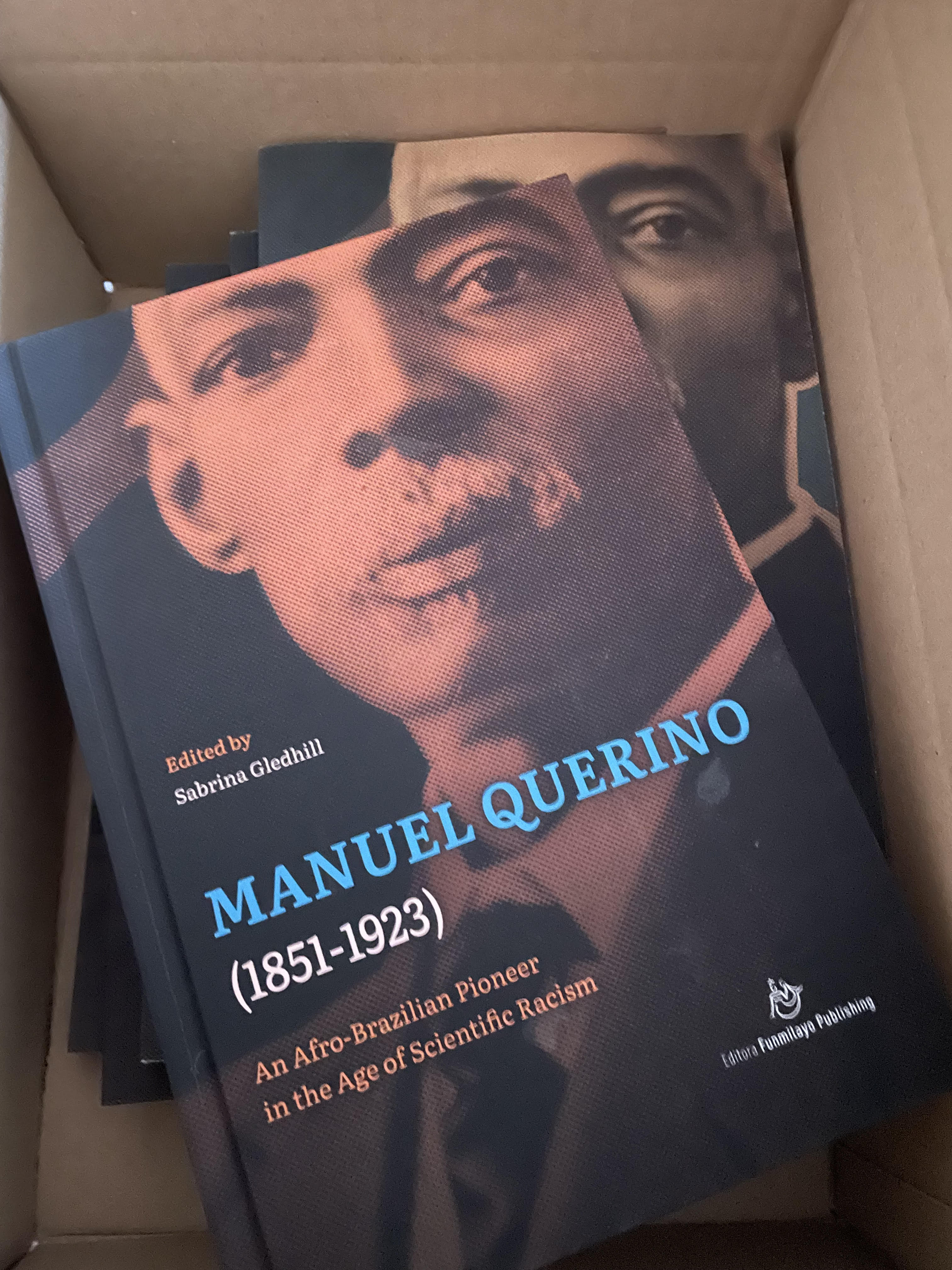
Manuel Querino: Activism and Education for Freed-persons

On 13 May 1888, the “Golden Law” officially abolished slavery in Brazil – the last country in the Americas to do so. For abolitionists like Manuel Querino, it was a huge achievement. The following year, a coup overthrew the monarchy, exiled Pedro II and his family – including Princess Isabel, the signatory of the “Golden Law” – and established the First Republic. As a life-long republican, Querino must have felt that this, too, was a dream come true, the outcome of many hard-fought struggles. Unfortunately for him and, even more so, the people recently emancipated from slavery, the new republic did not represent a step forward for Black people or their culture. Instead, it viewed Afro-Brazilian culture as “backward” and many of its expressions were criminalised, including candomblé and capoeira. Worse, the new government defunded or closed schools that had once provided vocational and higher education that would have been accessible to the poor, including those whose emancipation brought no reparations. Querino was aware of this, protested it and even felt the consequences.

Because of all the difficulties, obstacles and challenges freed-persons faced during the post-Abolition period, 13 May has become a controversial date for Black activists and their allies. Is it really something to celebrate? Today, November is Brazil’s Black History Month. Black Consciousness Day is celebrated on 20 November, the date when Zumbi dos Palmares, the last leader of possibly the oldest and certainly the best known quilombo or maroon community, was betrayed and killed.

Despite the controversy, I am sure that Querino and many Black activists like him would have celebrated 13 May in his day as a major milestone in Brazilian history – one that he personally worked hard to achieve as a militant journalist and activist.

To learn more about Querino’s fight against racism and support for the education of freed-persons, read Black Atlantic Crossings and Manuel Querino (1851-1923), available on Amazon and other online booksellers.

The Roots of Black Dandies and Fashion at the Met Gala

In 2025, the theme of the Met Gala was “Black dandies,” a phenomenon believed to date back 400 years, since the Black diaspora forcibly began. I was struck by the connection with chapter 5 of Black Atlantic Crossings, which focusses on the anti-racist tactic of portraying Black people in “gala dress.” Booker T. Washington was very careful to depict the faculty and students of the Tuskegee Institute (now an historically Black university) in a dignified manner and suppressed any images that might reinforce negative stereotypes. Manuel R. Querino went even further, by publishing photographs of Black people who practised a then-stigmatised and proscribed (read, illegal) religion and enslaved people who were clearly proud of their appearance. I particularly love the photographs of two iyalorishas (high priestesses) of one of Brazil’s best known Afro-Brazilian religious communities, the Gantois terreiro in Salvador, Bahia. Here is one of those photos:

HIgh priestess of the Gantois Afro-Brazilian religious community

Note her regal pose, not unlike the cartes de visite produced by royalty, as well as her gorgeous jewellery and sumptuous clothing. The African wrapper draped over her shoulder is an insignia of her rank. Her name was Maria Júlia da Conceição Nazaré, the founder of the Ilê Axé Iyá Omin Iyamassê, better known as Gantois.

On Historical Erasure

Heather Cox Richardson’s “Letters from an American” on March 17, 2025, documented the current US administration’s removal of content related to people of colour, women, and anyone else considered “DEI” from government websites, including figures buried in Arlington Cemetery and the Navajo code talkers. This is a real and present instance of the historical erasure my research seeks to counter. My edition of The Need for Heroes: Black Intellectuals Dig Up Their Past was published in 2024 precisely to amplify Black scholars’ voices and ensure the preservation of historical narratives about soldiers and maroons of African descent, narratives that must be repeatedly shared and republished to prevent their being forgotten. That same year, I also published Heroes Sung and Unsung: Black Artists in World History. The title speaks for itself.

Carrying on this work, my forthcoming publication, Black Atlantic Crossings: The Lives and Anti-Racist Tactics of Booker T. Washington and Manuel R. Querino, expands on these themes. Here is the genesis of this book:

In the mid-1980s, I stumbled upon a figure who was largely unknown outside Brazil. Manuel Querino, an Afro-Brazilian polymath, was quoted in the epigraph to Jorge Amado’s Tent of Miracles. As I was then pursuing an MA in Latin American Studies at UCLA, I mentioned Querino to my supervisor, the esteemed E. Bradford Burns. It turned out that he had not only published an article about Querino and translated the introduction to one of his works but he had also featured Querino prominently in his History of Brazil. Rather than a biography, Professor Burns encouraged me to delve into a comparative study, contrasting Querino’s perspectives on Africans and their descendants with those of other Brazilian intellectuals active before 1930—a pivotal year when the academic study of Africans and their descendants gained acceptance in Brazil. These intellectuals included Nina Rodrigues, whom I positioned at one extreme of the spectrum of “racial pessimism,” with Querino at the other. Nina not only believed in Black inferiority but also that mixed-race people were destined to die out due to their moral and physical frailties.

In late 1986, I went to Brazil for preliminary PhD research and ended up staying for twenty-eight years—but that’s another story . While I hadn’t planned to continue studying Querino, I was incensed by the distortions of his legacy. Worse than being erased, his reputation had been actively tarnished by overtly racist interpretations of his life and work. For example, it was wrongly assumed that he died a pauper and was insignificant because he was buried in a “poor people’s cemetery” (a claim proven inaccurate). Academics cast doubt on whether Querino was the inspiration for Pedro Archanjo, the protagonist of Amado’s Tent of Miracles. His scholarly output was also underestimated. Meanwhile, Nina Rodrigues was celebrated as the father of anthropology in Brazil. Fortunately, I was not the only one who was passionate about defending Querino’s memory and retelling his story—accurately, this time. Scholars like Jaime Nascimento and Maria das Graças de Andrade Leal were also writing and editing books about him. Nascimento organised seminars and lectures and graciously included me in the line-up of speakers.

By the time I finally went on for a PhD at the Universidade Federal da Bahia (UFBA) in 2010, Leal had published a biography of Querino focussing on his work as a politician and labour leader. My interest was still focussed on his defence of Africans and their descendants, but since my PhD thesis had to be “original”, I decided to compare and contrast Querino with Booker T. Washington, a Black educator the Afro-Brazilian scholar specifically admired. The result was a study that was published in Brazil in 2020 as Travessias no Atlântico Negro: reflexões sobre Booker T. Washington e Manuel R. Querino. An expanded, updated translation is now in press, entitled Black Atlantic Crossings: The Lives and Anti-Racist Tactics of Booker T. Washington and Manuel R. Querino.