
The full colour e-book, hardcover, and paperback editions will be released on 15 December 2025, but the black-and-white paperback is available now!
The full colour e-book, hardcover, and paperback editions will be released on 15 December 2025, but the black-and-white paperback is available now!

Black Atlantic Crossings by Sabrina Gledhill examines the lives and anti-racist tactics of Booker T. Washington and Manuel R. Querino, two influential figures in the Black Atlantic world whose contributions have often been overlooked or belittled. Challenging this historical erasure, the book argues that these figures were not merely products of their respective national contexts (the United States and Brazil) but rather transatlantic intellectuals who navigated and challenged the racialised boundaries of their time. It emphasises the interconnectedness of Black experiences and intellectual movements across the Atlantic, highlighting how Washington and Querino, despite their geographical distance, shared common concerns and engaged in vital transnational dialogues. Furthermore, it analyses the strategies and tactics they employed to combat racism and promote social justice within their societies, including their engagement with education, politics, and cultural production, ultimately offering a crucial rethinking of their lives, work, and enduring impact beyond narrow nationalistic frameworks.
The latest addition to Funmilayo’s Unsung Heroes series, Black Atlantic Crossings is now available in full-colour and black-and-white editions. You can find it on all major online booksellers, including Amazon and Waterstones.
Praise for Black Atlantic Crossings
As promised, Sabrina Gledhill’s research does, in fact, expand the Black Atlantic by putting into dialogue the ideas and activism of two giants of the African Diaspora in the Americas. The legacy of Booker T. Washington has been well known, including in Brazil, since the turn of the twentieth century. However, in addition to reinterpreting his legacy in a broader context, this book introduces the English-speaking reader to Manuel Querino, an insightful and multifaceted Afro-Brazilian thinker who is little known outside Brazil. Enjoy reading this original work, which is destined to become a classic.
João José Reis, Universidade Federal da Bahia, author of Slave Rebellion in Brazil
Black Atlantic Crossings is a timely reflection on the challenges that African American intellectuals faced in the aftermaths of slavery in Brazil and the United States. While not always understood or accepted by later commentators, the anti-racist activism of Manoel Raimundo Querino and Booker T. Washington, ably analyzed by Sabrina Gledhill, profoundly challenged the emerging post-slavery hierarchies. She demonstrates that there is much to learn from these two men’s lives and the evolution of their historical memory in the century since their deaths.
Hendrik Kraay, University of Calgary, author of Bahia’s Independence: Popular Politics and Patriotic Festival in Salvador, Brazil, 1824-1900
Crossing the Atlantic requires navigating a sea of stories through rough and calm waters, amidst fleeting encounters and enduring dialogues. In this insightful work, Sabrina Gledhill offers more than just a theoretical compass. Her sophisticated approach reveals the profound oceanic connections that shaped Booker T. Washington and Manuel R. Querino, revisiting them as original Atlantic characters, without borders, but with transnational margins.
Flavio dos Santos Gomes, Universidade Federal do Rio de Janeiro, co-author of The Story of Rufino: Slavery, Freedom, and Islam in the Black Atlantic
On 13 May 1888, the “Golden Law” officially abolished slavery in Brazil – the last country in the Americas to do so. For abolitionists like Manuel Querino, it was a huge achievement. The following year, a coup overthrew the monarchy, exiled Pedro II and his family – including Princess Isabel, the signatory of the “Golden Law” – and established the First Republic. As a life-long republican, Querino must have felt that this, too, was a dream come true, the outcome of many hard-fought struggles. Unfortunately for him and, even more so, the people recently emancipated from slavery, the new republic did not represent a step forward for Black people or their culture. Instead, it viewed Afro-Brazilian culture as “backward” and many of its expressions were criminalised, including candomblé and capoeira. Worse, the new government defunded or closed schools that had once provided vocational and higher education that would have been accessible to the poor, including those whose emancipation brought no reparations. Querino was aware of this, protested it and even felt the consequences.
Because of all the difficulties, obstacles and challenges freed-persons faced during the post-Abolition period, 13 May has become a controversial date for Black activists and their allies. Is it really something to celebrate? Today, November is Brazil’s Black History Month. Black Consciousness Day is celebrated on 20 November, the date when Zumbi dos Palmares, the last leader of possibly the oldest and certainly the best known quilombo or maroon community, was betrayed and killed.
Despite the controversy, I am sure that Querino and many Black activists like him would have celebrated 13 May in his day as a major milestone in Brazilian history – one that he personally worked hard to achieve as a militant journalist and activist.
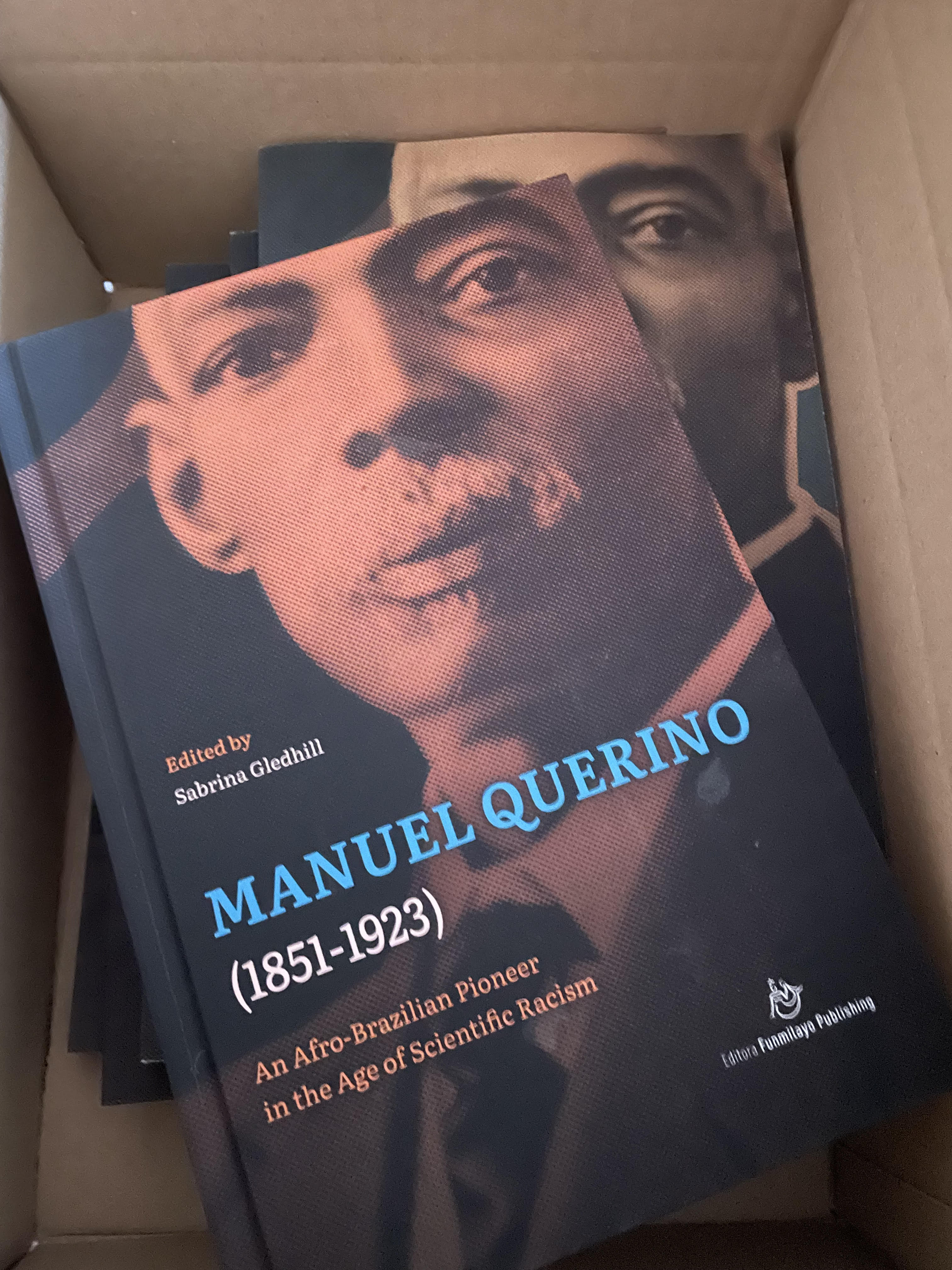
To learn more about Querino’s fight against racism and support for the education of freed-persons, read Black Atlantic Crossings and Manuel Querino (1851-1923), available on Amazon and other online booksellers.
I am delighted to share these blurbs from highly respected scholars:
As promised, Sabrina Gledhill’s research does, in fact, expand the Black Atlantic by putting into dialogue the ideas and activism of two giants of the African Diaspora in the Americas. The legacy of Booker T. Washington has been well known, including in Brazil, since the turn of the twentieth century. However, in addition to reinterpreting his legacy in a broader context, this book introduces the English-speaking reader to Manuel Querino, an insightful and multifaceted Afro-Brazilian thinker who is little known outside Brazil. Enjoy reading this original work, which is destined to become a classic.
João José Reis, Universidade Federal da Bahia, author of Slave Rebellion in Brazil: The Muslim Uprising of 1835 in Bahia
Black Atlantic Crossings is a timely reflection on the challenges that African American intellectuals faced in the aftermaths of slavery in Brazil and the United States. While not always understood or accepted by later commentators, the anti-racist activism of Manoel Raimundo Querino and Booker T. Washington, ably analyzed by Sabrina Gledhill, profoundly challenged the emerging post-slavery hierarchies. She demonstrates that there is much to learn from these two men’s lives and the evolution of their historical memory in the century since their deaths.
Hendrik Kraay, University of Calgary, author of Bahia’s Independence: Popular Politics and Patriotic Festival in Salvador, Brazil, 1824-1900
Crossing the Atlantic requires navigating a sea of stories through rough and calm waters, amidst fleeting encounters and enduring dialogues. In this insightful work, Sabrina Gledhill offers more than just a theoretical compass. Her sophisticated approach reveals the profound oceanic connections that shaped Booker T. Washington and Manuel R. Querino, revisiting them as original Atlantic characters, without borders, but with transnational margins.
Flavio dos Santos Gomes, Universidade Federal do Rio de Janeiro, co-author of The Story of Rufino: Slavery, Freedom, and Islam in the Black Atlantic
Great news! Black Atlantic Crossings is officially here in Kindle e-book. paperback, and hardcover editions. Find your copy today at Amazon, Waterstones, and other booksellers.

Heather Cox Richardson’s “Letters from an American” on March 17, 2025, documented the current US administration’s removal of content related to people of colour, women, and anyone else considered “DEI” from government websites, including figures buried in Arlington Cemetery and the Navajo code talkers. This is a real and present instance of the historical erasure my research seeks to counter. My edition of The Need for Heroes: Black Intellectuals Dig Up Their Past was published in 2024 precisely to amplify Black scholars’ voices and ensure the preservation of historical narratives about soldiers and maroons of African descent, narratives that must be repeatedly shared and republished to prevent their being forgotten. That same year, I also published Heroes Sung and Unsung: Black Artists in World History. The title speaks for itself.
Carrying on this work, my forthcoming publication, Black Atlantic Crossings: The Lives and Anti-Racist Tactics of Booker T. Washington and Manuel R. Querino, expands on these themes. Here is the genesis of this book:
In the mid-1980s, I stumbled upon a figure who was largely unknown outside Brazil. Manuel Querino, an Afro-Brazilian polymath, was quoted in the epigraph to Jorge Amado’s Tent of Miracles. As I was then pursuing an MA in Latin American Studies at UCLA, I mentioned Querino to my supervisor, the esteemed E. Bradford Burns. It turned out that he had not only published an article about Querino and translated the introduction to one of his works but he had also featured Querino prominently in his History of Brazil. Rather than a biography, Professor Burns encouraged me to delve into a comparative study, contrasting Querino’s perspectives on Africans and their descendants with those of other Brazilian intellectuals active before 1930—a pivotal year when the academic study of Africans and their descendants gained acceptance in Brazil. These intellectuals included Nina Rodrigues, whom I positioned at one extreme of the spectrum of “racial pessimism,” with Querino at the other. Nina not only believed in Black inferiority but also that mixed-race people were destined to die out due to their moral and physical frailties.
In late 1986, I went to Brazil for preliminary PhD research and ended up staying for twenty-eight years—but that’s another story . While I hadn’t planned to continue studying Querino, I was incensed by the distortions of his legacy. Worse than being erased, his reputation had been actively tarnished by overtly racist interpretations of his life and work. For example, it was wrongly assumed that he died a pauper and was insignificant because he was buried in a “poor people’s cemetery” (a claim proven inaccurate). Academics cast doubt on whether Querino was the inspiration for Pedro Archanjo, the protagonist of Amado’s Tent of Miracles. His scholarly output was also underestimated. Meanwhile, Nina Rodrigues was celebrated as the father of anthropology in Brazil. Fortunately, I was not the only one who was passionate about defending Querino’s memory and retelling his story—accurately, this time. Scholars like Jaime Nascimento and Maria das Graças de Andrade Leal were also writing and editing books about him. Nascimento organised seminars and lectures and graciously included me in the line-up of speakers.
By the time I finally went on for a PhD at the Universidade Federal da Bahia (UFBA) in 2010, Leal had published a biography of Querino focussing on his work as a politician and labour leader. My interest was still focussed on his defence of Africans and their descendants, but since my PhD thesis had to be “original”, I decided to compare and contrast Querino with Booker T. Washington, a Black educator the Afro-Brazilian scholar specifically admired. The result was a study that was published in Brazil in 2020 as Travessias no Atlântico Negro: reflexões sobre Booker T. Washington e Manuel R. Querino. An expanded, updated translation is now in press, entitled Black Atlantic Crossings: The Lives and Anti-Racist Tactics of Booker T. Washington and Manuel R. Querino.

Condemned as racist and exploitative of black women, this controversial advert for Devassa dark beer did something far worse
Last week, I attended a thought-provoking seminar, ‘Visualizing Blackness in Latin America & the Caribbean, 16th-19th Centuries‘, held on 29 & 30 May 2018, and organised by the Institute of Latin American Studies, School of Advanced Study, London. Among many other interesting topics, in her keynote lecture, “Colour and Undertones: On Black Subjects in Latin-American Visual Culture”, Dr Tamara J. Walker mentioned an advert for Devassa dark beer which sparked controversy in Brazil a few years ago. In 2012, the National Council for Self-Regulation in Advertising (Conar) determined that the makers of Devassa – a product line that also includes a ‘blonde’ beer, and whose name is defined as ‘woman devoid of modesty or morals with regard to sex’, which could be translated as ‘slag’, ‘slut’ or worse – had to change the advert, as it was considered racist, a crime under Brazilian law.
When I saw the advert again after all these years, something else struck me about the image. Everyone at the seminar agreed that the woman portrayed is lovely and sexy in the old-fashioned pin-up style of glamour. The racism is more to be found in the text, which reads: ‘you can tell a true black woman [dark beer] by her [its] body’ (as the word for beer is feminine in Portuguese, this sort of double entendre is easily conveyed).
The main problem I saw with the image was that, according to Brazilian racial categories, the woman portrayed is not ‘black’ at all, but the classic sexualised and romanticised ‘mulata’ (once known in English as a ‘mulattress’). In other words, the text of the advert is not only racist and sexist, but the image has failed to represent black women as presumably intended – thereby effectively de/visualizing them and deleting them from the picture.
I had some difficulty explaining this to an African-American scholar, presumably because the one-drop rule in the US has led to greater solidarity and unified self-identification among a relatively small portion of the population, based on ancestry and the common experience of historical enslavement (as I argue in my PhD thesis, President Obama was only legitimised as a representative of the African-American community by his wife, Michelle, as his father came directly from Africa and therefore did not share that experience of historical enslavement), whereas in Brazil, African ancestry is so widespread that many people who would be considered black elsewhere see themselves as white or ‘brown’ (pardo). As a result, ‘blackness’ is based on appearance and placed at one extreme of a continuum, the other end of which is ‘whiteness’. There are many shades and categories in between.
In Brazil, ‘race’ is identified not through ancestry but through markers – particularly skin colour, features and hair. Although she has full lips – de rigueur among models and actresses of any ethnicity nowadays – the features of the woman in the advert are European and considered attractive according to the white racialist aesthetic, particularly her nose. Even among the very few black women who make it into the modelling world in Brazil, there is a distinct preference for those with a ‘nariz afinada’ – an aquiline or Roman nose. This is nothing new, as racialist discourse has long given preference to such noses, seeing them as superior to ‘snub’ or ‘broad/flat’ breathing apparatus (N.B. by way of full disclosure, I have a ‘snub’ or ‘retroussé’ nose, and although, as far as I am aware, I am ‘white’, a white supremacist once told me that I could be black, based on the shape of my nose and lips).
As I pointed out to my African-American interlocutor – and I hope I made clear then and now – I am not denying that the fictional woman portrayed could, and probably would, self-identify as black in Brazil. I am not negating her self-perceived Blackness. The problem with the picture is that, to be truly ‘black’ by Brazilian lights – especially in Bahia – she should look more like Zezé Mota or Taís Araújo. Better yet, to mention a more familiar example for non-Brazilians, she should strongly resemble Lupita Nyong’o.

Graffiti artists’ protest against the Cabula massacre, seen in that district in 2015. Photo by Sabrina Gledhill (all rights reserved)
On 6 February, 2015, policemen shot and killed 12 robbery suspects in the Cabula district of Salvador, Bahia. An internal investigation by state’s Public Prosecutor’s office found that the victims – all of them young black men – had been executed. The black movement calls it genocide, a disturbing trend in a country where racism has traditionally been veiled and racially motivated lynching almost unheard of. That being said, exterminating street children (the best-known incident being the Candelaria massacre in Rio in 1993) and known or suspected criminals as if they were vermin is nothing new in Brazil. Ironically, there is no official death penalty in that country.
***
The graffiti art in the photo illustrating this post was not the only response to the Cabula massacre by the Bahian arts community. From May to August 2015, the Museu Afro-Brasileiro (MAFRO) held an exhibition curated by the museum’s director, Graça Teixeira that displayed thought-provoking installations and artworks protesting the genocide of black youth in Brazil.
I recently came across an article that has sparked all kinds of responses online, and the time has come to add one of my own. Titled Future Humans Will All Look Brazilian, Researcher Says it naturally caught my eye! Without even reading it, my first question was, which Brazilians, from where?
While I was brunching in Paris with a fellow Brit, two women asked to share our table and started speaking Spanish. I initially assumed they were from Spain, since we were in Europe. Also, one was “Mediterranean” looking and the other was a blue-eyed blonde, which is entirely possible in Iberia. When we eventually joined in the conversation (in English), it turned out that the “Mediterranean” woman was from Argentina and the blonde was…wait for it…from Brazil! My British companion was surprised, and said she didn’t look Brazilian. I explained that they come in all shapes and sizes.
The reason for that is immigration – and a policy of “whitening” that began in the 19th century. There is a large population of German descent in southern Brazil whose best-known representative nowadays is Gisele Bundschen (note the German-sounding surname!). It comes as a surprise to some that long before the influx of Nazis on the run after Hitler’s defeat in the mid-1940s, a much bigger wave of migrants arrived in what is now the state of Santa Catarina in the 1800s from the region now called Germany. There is even a city called Blumenau, founded in 1850, that holds an annual Oktoberfest.
Many Italians settled in the Central South, and there is a large population of Italian descent in São Paulo. A popular soap opera, Terra Nostra (1999-2000), portrayed the stories of white immigrants from Italy who replaced enslaved Black people’s labour on coffee farms in São Paulo State at the turn of the nineteenth/twentieth centuries.
Centuries of racial mixture and immigration, not only from Europe but from Asia and other parts of South America, as well as more recent arrivals from Africa (particularly former Portuguese colonies) have produced Brazilians of all colours on a wide spectrum ranging from Pelé to Gisele and even paler and blonder than she (like TV children’s presenter Xuxa Meneghel, also Pelé’s former girlfriend). However, there is an image of what Brazilians should look like, formed among Brazilians themselves.
The original “three sad races” of Brazil are Amerindians, Europeans and Africans, in order of arrival, and the population that resulted from that mixture is considered “typically” Brazilian. For that reason, people of Asian descent, for example, may never be considered 100% Brazilian. A third-generation Sansei will find him or herself referred to as “Japa” because of their appearance. I have read of cases where Nipo-Brazilian workers in Japan – dekasseguis – feel more Brazilian outside their country than they do at home.
For more information on race relations in Brazil today, see my entry on that subject in the Brazil Today encyclopaedia

Xuxa and Pelé when they were dating

It often happens that people from different backgrounds come to Brazil, visit one or two parts of the country, and reach general conclusions based on their own specific experience. It is like the Indian fable of the blind men and the elephant, each of whom concludes that the creature is a rope, spear, wall or tree trunk based on the part they have been able to touch – a slender tail, a sharp ivory tusk, a broad flank, or a stout, round leg. Well, Brazil is just like that elephant – the sum of its very different parts. Not only that, but the response a visitor will get depends on several factors: national origin, skin colour, and above all, money – or lack thereof.
A wealthy white woman who can afford assistants, nannies, tour guides and the best hotels, will find herself showered with love. If her baby scatters food all over the table and crawls on the floor of a restaurant, the waiters and cleaners will grit their teeth and only speak up when the tyke gets too close to the stairs. If the visitor is a woman of colour with a small baby, she might get some sympathy. Then again, people might assume she is the nanny. If she finds herself in the wrong neighbourhood, she could get caught up in the sweep of “undesirables” leading up to the World Cup. And if the woman of colour has money, she had better show it – appearances are everything.
An African American clad in Gucci or Prada will never feel the sting of racial discrimination, but woe betide a member of that community who turns up in an old T-shirt, flip-flops and bermuda shorts. Until they open their mouths and display their accents – or complete lack of Portuguese – they could find themselves lined up with the usual suspects, or worse. Younger African American women will be considered sex objects in Brazil. If they stay at a fancy hotel, they could find themselves treated like hookers and refused service at the restaurant. Unless they’re wearing Gucci or Prada…
 It’s been quite a while since I’ve posted on this blog. I’ve been inspired to get back to it by a British blogger who is visiting Brazil and posting her impressions. I also get questions on Brazil – especially race relations – via Facebook, which has been my main “blogging” platform for the past few years (basically because I’ve been too busy to sit down and write). What has changed? Today is Mardi Gras – an official holiday in Brazil. Plus, I turned in my dissertation on 18th February – I’m due to defend it on 18th March – so I can focus on other things. To start with, here’s a link to an entry I wrote for Brazil Today: An Encyclopedia of Life in the Republic, titled Race Relations in Brazil Today I welcome your comments and questions (especially those which can’t be answered by Googling).
 Editora Funmilayo Publishing