Black Atlantic Crossings: The Lives and Anti-Racist Tactics of Booker T. Washington and Manuel R. Querino

Black Atlantic Crossings by Sabrina Gledhill examines the lives and anti-racist tactics of Booker T. Washington and Manuel R. Querino, two influential figures in the Black Atlantic world whose contributions have often been overlooked or belittled. Challenging this historical erasure, the book argues that these figures were not merely products of their respective national contexts (the United States and Brazil) but rather transatlantic intellectuals who navigated and challenged the racialised boundaries of their time. It emphasises the interconnectedness of Black experiences and intellectual movements across the Atlantic, highlighting how Washington and Querino, despite their geographical distance, shared common concerns and engaged in vital transnational dialogues. Furthermore, it analyses the strategies and tactics they employed to combat racism and promote social justice within their societies, including their engagement with education, politics, and cultural production, ultimately offering a crucial rethinking of their lives, work, and enduring impact beyond narrow nationalistic frameworks.

The latest addition to Funmilayo’s Unsung Heroes series, Black Atlantic Crossings is now available in full-colour and black-and-white editions. You can find it on all major online booksellers, including Amazon and Waterstones.

Praise for Black Atlantic Crossings
As promised, Sabrina Gledhill’s research does, in fact, expand the Black Atlantic by putting into dialogue the ideas and activism of two giants of the African Diaspora in the Americas. The legacy of Booker T. Washington has been well known, including in Brazil, since the turn of the twentieth century. However, in addition to reinterpreting his legacy in a broader context, this book introduces the English-speaking reader to Manuel Querino, an insightful and multifaceted Afro-Brazilian thinker who is little known outside Brazil. Enjoy reading this original work, which is destined to become a classic.
João José Reis, Universidade Federal da Bahia, author of Slave Rebellion in Brazil

Black Atlantic Crossings is a timely reflection on the challenges that African American intellectuals faced in the aftermaths of slavery in Brazil and the United States. While not always understood or accepted by later commentators, the anti-racist activism of Manoel Raimundo Querino and Booker T. Washington, ably analyzed by Sabrina Gledhill, profoundly challenged the emerging post-slavery hierarchies. She demonstrates that there is much to learn from these two men’s lives and the evolution of their historical memory in the century since their deaths.
Hendrik Kraay, University of Calgary, author of Bahia’s Independence: Popular Politics and Patriotic Festival in Salvador, Brazil, 1824-1900

Crossing the Atlantic requires navigating a sea of stories through rough and calm waters, amidst fleeting encounters and enduring dialogues. In this insightful work, Sabrina Gledhill offers more than just a theoretical compass. Her sophisticated approach reveals the profound oceanic connections that shaped Booker T. Washington and Manuel R. Querino, revisiting them as original Atlantic characters, without borders, but with transnational margins.
Flavio dos Santos Gomes, Universidade Federal do Rio de Janeiro, co-author of The Story of Rufino: Slavery, Freedom, and Islam in the Black Atlantic

The Roots of Black Dandies and Fashion at the Met Gala

In 2025, the theme of the Met Gala was “Black dandies,” a phenomenon believed to date back 400 years, since the Black diaspora forcibly began. I was struck by the connection with chapter 5 of Black Atlantic Crossings, which focusses on the anti-racist tactic of portraying Black people in “gala dress.” Booker T. Washington was very careful to depict the faculty and students of the Tuskegee Institute (now an historically Black university) in a dignified manner and suppressed any images that might reinforce negative stereotypes. Manuel R. Querino went even further, by publishing photographs of Black people who practised a then-stigmatised and proscribed (read, illegal) religion and enslaved people who were clearly proud of their appearance. I particularly love the photographs of two iyalorishas (high priestesses) of one of Brazil’s best known Afro-Brazilian religious communities, the Gantois terreiro in Salvador, Bahia. Here is one of those photos:

HIgh priestess of the Gantois Afro-Brazilian religious community

Note her regal pose, not unlike the cartes de visite produced by royalty, as well as her gorgeous jewellery and sumptuous clothing. The African wrapper draped over her shoulder is an insignia of her rank. Her name was Maria Júlia da Conceição Nazaré, the founder of the Ilê Axé Iyá Omin Iyamassê, better known as Gantois.

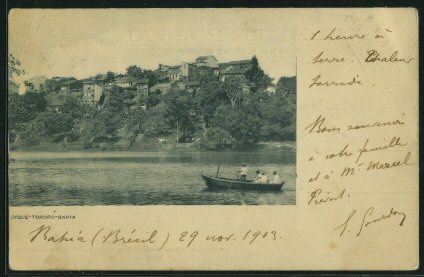
Dique do Tororó – Salvador’s fowl-free Serpentine

Image

 Postcard of the Dique do Toróro at the turn of the century

Link to photos of the Dique when there were geese (scroll down)

I love to drive by the Dique do Tororó – an artificial lagoon encrusted in the heart of Salvador, Bahia. If you look at the water and its landscaped surroundings, you will almost feel that you have found London’s Hyde Park in the tropics – at least, the Serpentine. But if you look in the other direction, you will see jumbled heaps of motley brick dwellings sprouting almost organically from the hillsides. And this is where the European concept of a manicured urban oasis cum sculpture garden misses out on the most important factor – in my mind – the swans, ducks and geese that are the main adornment of any London park, or English river, for that matter. Attempts have been made to introduce different kinds of wildfowl into the Tororó landscape, but they have all met with foul play. In other words, they ended up on someone’s dinner table. Until the problems of poverty and the attendant hunger pangs are solved in the surrounding neighbourhoods, the wings of wild geese will never shimmer over the waters of Tororó.

 Image

Aerial view of Dique do Tororó – taken before the construction of the present-day Fonte Nova Arena

FrenchMottershead’s SHOPS project

FrenchMottershead visited Bahia from January 7th to 27th to work on SHOPS, “an ongoing, international photographic project, uncovering communities formed by independent, local traders”. I worked with them as a writer/observer/cultural consultant and am currently writing an essay on that experience for the book they will publish in 2009. Here is their blog on the project so far: shopsproject.blogspot.com

10 Feb 08 – They’ve just added a “making links” blog

Yemanjá Festival on Itaparica

Yesterday, I had the privilege of attending a very special Yemanjá Festival in Barra Grande, on the island of Itaparica. This year, February 3rd fell during Carnival, so the festivities were significantly reduced. Even so, they were beautiful and deeply moving. Here are some of the photos I thought best captured the event (just click on the photo to see the slideshow).

Yemanjá Day on Itaparica – 03.02.08