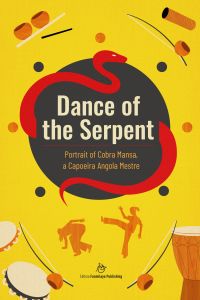
The full colour e-book, hardcover, and paperback editions will be released on 15 December 2025, but the black-and-white paperback is available now!
Editora Funmilayo Publishing is thrilled to announce that Dance of the Serpent: Portrait of Cobra Mansa, a Capoeira Angola Mestre is now available for Kindle pre-order!
Witness the astonishing journey of Mestre Cobra Mansa, who rose from the poverty-stricken streets of a Rio de Janeiro suburb to become a global icon of the Afro-Brazilian martial art. This definitive biography tracks his life from mastering the deceptive jogo of Capoeira Angola to dedicating his later career to environmental justice and permaculture in Brazil.
If you love stories of profound personal transformation, cultural preservation, and resilience, secure your digital copy today.
Release Date: 15 December 2025
Click here to pre-order Dance of the Serpent

Editora Funmilayo Publishing is pleased to announce the upcoming publication of Dance of the Serpent: Portrait of Cobra Mansa, a Capoeira Angola Mestre, the definitive biography of one of the most influential figures in the Afro-Brazilian martial art/dance capoeira. Due out on 15 December 2025, the book traces the astonishing journey of a man who rose from the poverty-stricken streets of a Rio de Janeiro suburb to become a global master, transforming a martial art into a way of life, and dedicating his later career to environmental and social justice.
Mestre (Master) Cobra Mansa’s life is a profound testament to the power of Capoeira Angola as a tool for personal and communal liberation. Born in the deprived town of Duque de Caxias, he initially found refuge and strength in the practice, mastering the deceptive, strategic movements of the jogo (the game). He quickly ascended through the ranks of the GCAP (Grupo de Capoeira Angola Pelourinho), the organization founded by his mentor, Mestre Moraes. Along the way, he earned a PhD and became Dr Cobra Mansa.
The book details how, as a young man, Cobra Mansa became instrumental in establishing Capoeira Angola in the United States and worldwide. He has spent decades travelling, ensuring the art—a living link to the history of the Forced African Diaspora—retained its cultural authenticity and philosophical depth, always emphasizing that capoeira is more than a practice; it is a dynamic way of existing in the world.
The biography also examines the Mestre’s social activism. After teaching in the USA, Cobra Mansa returned to Brazil to found Kilombo Tenondé, an Afro-Brazilian centre dedicated to preserving the cultural heritage of Afro-Brazilians and Indigenous people while practicing permaculture and sustainable farming. His current mission is the preservation of ancestral wisdom and the construction of autonomous, thriving communities.
Dance of the Serpent is an essential read for enthusiasts of martial arts, Black history, cultural studies, and anyone seeking an inspiring account of transformation and purpose.
About Mestre Cobra Mansa
Mestre Cobra Mansa is a renowned master of Capoeira Angola, recognized globally for his deep understanding of the art’s African roots. His life has been dedicated to teaching, preserving cultural heritage, and applying the philosophies of Capoeira to environmental and community development projects in Brazil.
Mestre Cobra Mansa, Moscow, 24 April 2007. Photo by Zac Allan. Source: Wikimedia Commons / Public Domain
Black History Month (BHM) in the UK, observed every October, is a vital annual affirmation of the continuous and profound contributions of people of African and African Caribbean descent to British life. This month provides a crucial, focussed period to move beyond narrow, often fragmented historical narratives and instead highlight the sprawling, centuries-long legacy of Black individuals who have shaped society, culture, and intellectual life globally. While this annual celebration is necessary, its deeper purpose is to seed the knowledge and understanding that must take root all year long.
The history recognised during BHM is one defined by both immense resilience and extraordinary creativity. We rightly honour the legacies of the Windrush generation and literary voices like Bernardine Evaristo and Zadie Smith. Yet, the crucial task is to move beyond the surface and uncover the foundational stories that support them. This commitment to wide recognition is central to Funmilayo’s mission, perfectly embodied by titles such as The Need for Heroes, which powerfully advocates for recognizing aspirational Black leadership, and Heroes Sung and Unsung, which is dedicated to illuminating the pioneering figures often overlooked by mainstream history. These works remind us that heroism and talent exist at all levels of society, waiting to be acknowledged.
BHM demands that we understand Black history not just as a British concern, but as a global, interconnected force. We must look beyond national borders to grasp the full scope of Black intellectual achievements. For instance, Funmilayo’s scholarship on the Afro-Brazilian polymath, Manuel Querino (1851–1923): An Afro-Brazilian Pioneer in the Age of Scientific Racism, demonstrates how pioneering thought emerged in the face of brutal institutional racism. Further expanding this view is Black Atlantic Crossings, which emphasizes the vital transnational dialogues between figures separated by geography, challenging us to see Black experiences as an integral thread within the fabric of global history.
Ultimately, the dedicated month of October serves as a powerful catalyst for a broader cultural shift. By promoting the rigorous recovery and visibility found in publications like Black Atlantic Crossings and Heroes Sung and Unsung, we fulfill BHM’s promise. The month is a joyous celebration, but it is also a renewed promise to maintain a year-round focus where the accomplishments and heritage of all Black people, from the famous to the previously forgotten, are recognized, valued, and taught without end.

More than 40 professionals, mostly Black journalists, worked for over two years and eight months to produce the Querino Project, a series of podcasts and text feature stories that offer an Afro-centric look at history to explain Brazil today. The eight episodes are on air and have already been downloaded 810,000 times as of Oct. 28, 2022. The podcast has reached first place in both Spotify and Apple’s daily rankings of the most listened-to podcasts in Brazil.
“Querino has no journalistic scoop. No information is being revealed for the first time. Researchers have been publishing for a long time, some more recently. The big impact is one of novelty [to a wider audience]. We are learning things. Things that I, Tiago, even working from this viewpoint since 2018, didn’t know,” journalist Tiago Rogero, the creator of the project, told LatAm Journalism Review (LJR).
This is the third venture of Rogero, 34, into the world of non-fiction podcasts focusing on Afro-Brazilian culture and characters. In 2019 he produced Negra Voz, for O Globo newspaper, which won him the Vladimir Herzog Prize for Journalism and Human Rights in 2020. Then, he produced 30 episodes of Vidas Negras for Spotify.
One of the inspirations for Project Querino is the New York Times’ Project 1619, which similarly places the consequences of slavery in the United States at the center of the national narrative. Project 1619 refers to the year that the first slave ship landed in the United States bringing enslaved Africans. The event occurred one year before the celebrated arrival of the Mayflower ship with European settlers, which has a privileged place in American historiography.
“Every American child learns about the Mayflower, but virtually no American child learned about the White Lion [the ship that brought the first enslaved Africans to the country],” journalist Nikole Hannah-Jones, editor in charge of Project 1619, told NPR. “Blacks are largely treated as an asterisk in American history.”
Similarly, the Querino Project presents Black historical characters who are little known in classrooms. The name Querino is a tribute to one of them, the intellectual Manuel Querino, a Black man born free in 1851 in Bahia, in a Brazil that was still a slave country. Brazil abolished slavery completely only in 1888, and was the last country in the Americas to do so.
Querino distinguished himself as a journalist, teacher, artist, and politician. He published in 1918 the book O colono preto como fator da civilização brasileira [The Black settler as a factor in Brazilian civilization], a social sciences’ pioneering text which placed Afro-Brazilians in a protagonist role in the building of the nation. Before starting the research for the Querino Project, Rogero himself did not know who the Brazilian intellectual Manuel Querino was.
“He is the exception of the exception of the exception because he was a Black child who had the chance to study. Because of this he became a geometric drawing teacher, an artist, researcher, journalist, union leader. He has an incredible intellectual production that positions Afro-Brazilians as protagonists in the process of nation building, and not just as a mere accessory, which is what the official version of history at that time already did,” Rogero said.
Manuel Querino is introduced to the audience only in episode four of the podcast, O Colono Preto [The Black settler], in which Rogero delves into the roots of educational disparity in Brazil today, showing how access to public education was consistently denied even to free Blacks living in Brazil. At the same time, he connects the fact with how late the country implemented affirmative-action policies, only in the early 2000s, and how they are still a reason for division in society today.
Besides Querino, the project introduces the audience to figures such as Maria Felipe de Oliveira, a Black woman who played a decisive role in the battles of the war of independence at Bahia. Also, figures such as Father José Maurício Nunes Garcia, a musician and composer who conducted the mass that celebrated Brazil’s elevation from a colony to United Kingdom of Portugal.
What most surprised Rogero in his research work, however, was the observation that Brazil could have gotten rid of slavery long before 1888. In 1831, under pressure from England, Brazil prohibited the trafficking of enslaved people. The law, considered revolutionary for the time, guaranteed citizenship and freedom to people in slavery conditions brought to Brazil as of that date. But it was never complied with.
“There was a big national agreement to disregard this law until at least 1850, when a new law again prohibits human trafficking. The people who had entered since 1831, some 800,000, were supposed to be freed because their status was illegal. But a new big elite agreement kept them enslaved. When we get to 1888, abolition benefits mostly the descendants of those who arrived after 1831, and who, by law, should have been freed many years earlier,” Rogero said.
Historian Ynaê Lopes dos Santos, from the Fluminense Federal University, acted as a consultant for the Querino Project. She believes the significant audience numbers demonstrate a fundamental need to revisit Brazil’s history critically.
“One of the great accomplishments of Projeto Querino is making this critical perspective very accessible, as well as the stories that have been systematically silenced from the black population, showing that history is a field in dispute,” Lopes dos Santos told LJR. “In this sense, the Querino Project seems to be a fundamental tool for understanding Brazil today. A Brazil that is, without a doubt, a consequence of a set of options and political choices made by the Brazilian elite.”
Unlike Project 1619, originally conceived for magazine format and later transformed into a podcast, the Querino Project had its genesis as a podcast and only later generated text and image content, with feature stories and photographs published in the magazine Piauí, notable for its in-depth journalism. In the magazine, the choice of the podcast format as a priority was to expand access to the content.
“A podcast is free. Anyone with any cell phone can listen, they can listen to Querino. In addition, spoken media speaks directly to our ancestry and the orality of Afro-descendant people, which is very beautiful,” Rogero said. “When we do the podcast, it can be the hardest journalistic subject possible, but we have to make it like storytelling.”
The Querino Project was funded by the Ibirapitanga Institute, through a grant of R$626,808.51 (equivalent to USD 125,361.70). This amount covered the work of more than two years of a team of 40 people during the research and production of the podcast, and also the dissemination.
Like 1619, the Querino Project will also become a book, and there are conversations with video production companies for an audiovisual format adaptation. Rogero is also working to adapt the content for educational purposes, as he has heard from history teachers who are already using the podcast in their classrooms.
“Querino will continue for the next few years and our big focus is how to get this content into schools, especially public schools. Many teachers are already using the podcast in the classroom, although the language is not ideal. It’s a big concern of mine to make this content reach young people of school age,” Rogero said. “Querino can’t account for everything, but it’s our contribution, so that a more complete and complex version of the story can be known.”
We are thrilled to announce that Black Atlantic Crossings: The Lives and Anti-Racist Tactics of Booker T. Washington and Manuel R. Querino is now available for purchase at two major brick-and-mortar booksellers: Barnes & Noble and Waterstones (also online, of course).
Delve into this ground-breaking study by Sabrina Gledhill that re-examines the anti-racist strategies of two pivotal, yet often overlooked or disparaged, figures in Black Atlantic history: Booker T. Washington and Manuel R. Querino. This essential English translation, which has already garnered significant academic acclaim, offers a fresh perspective on their interconnected lives and enduring legacies in challenging racial injustice across the Atlantic.
Whether you prefer the in-depth read of a paperback or the durability of a hardcover, you can now find your copy of Black Atlantic Crossings at Barnes & Noble and Waterstones, as well as Amazon (a Kindle e-book edition is also available).
Don’t miss this crucial contribution to the understanding of intellectual thought and anti-racist activism in the Black Atlantic.
Find your copy today at Barnes & Noble and Waterstones
https://www.barnesandnoble.com/w/black-atlantic-crossings-sabrina-gledhill/1147370255#
https://www.waterstones.com/book/black-atlantic-crossings/sabrina-gledhill/9781068606458
We originally published Black Atlantic Crossings: The Lives and Anti-Racist Tactics of Booker T. Washington and Manuel R. Querino with full colour illustrations, but printing costs may make it unaffordable for many readers. As a result, we decided to publish an alternative paperback edition in black and white. (The cover is the same.) It costs £12.72 ($16.99 in the US) and is even available in Australia and Japan! https://amzn.eu/d/5V2BwqN

Mark your calendars! We’re thrilled to announce the upcoming publication of Black Atlantic Crossings: The Lives and Anti-Racist Tactics of Booker T. Washington and Manuel R. Querino on May 1st, 2025 (Labour Day)!
For the first time ever, English-speaking readers will have the opportunity to delve into this ground-breaking work exploring the lives and crucial anti-racist strategies of two pivotal figures in the Black Atlantic world.
Get ready to discover their interconnected stories and their powerful approaches to challenging racial injustice.
You can purchase your paperback or hardback copy from Amazon on May 1st! It’s already available as an e-book.
Black Atlantic Crossings will also be sold by other booksellers, including Waterstones, shortly after the initial release.
We can’t wait for you to embark on this important journey with us. Share the news!