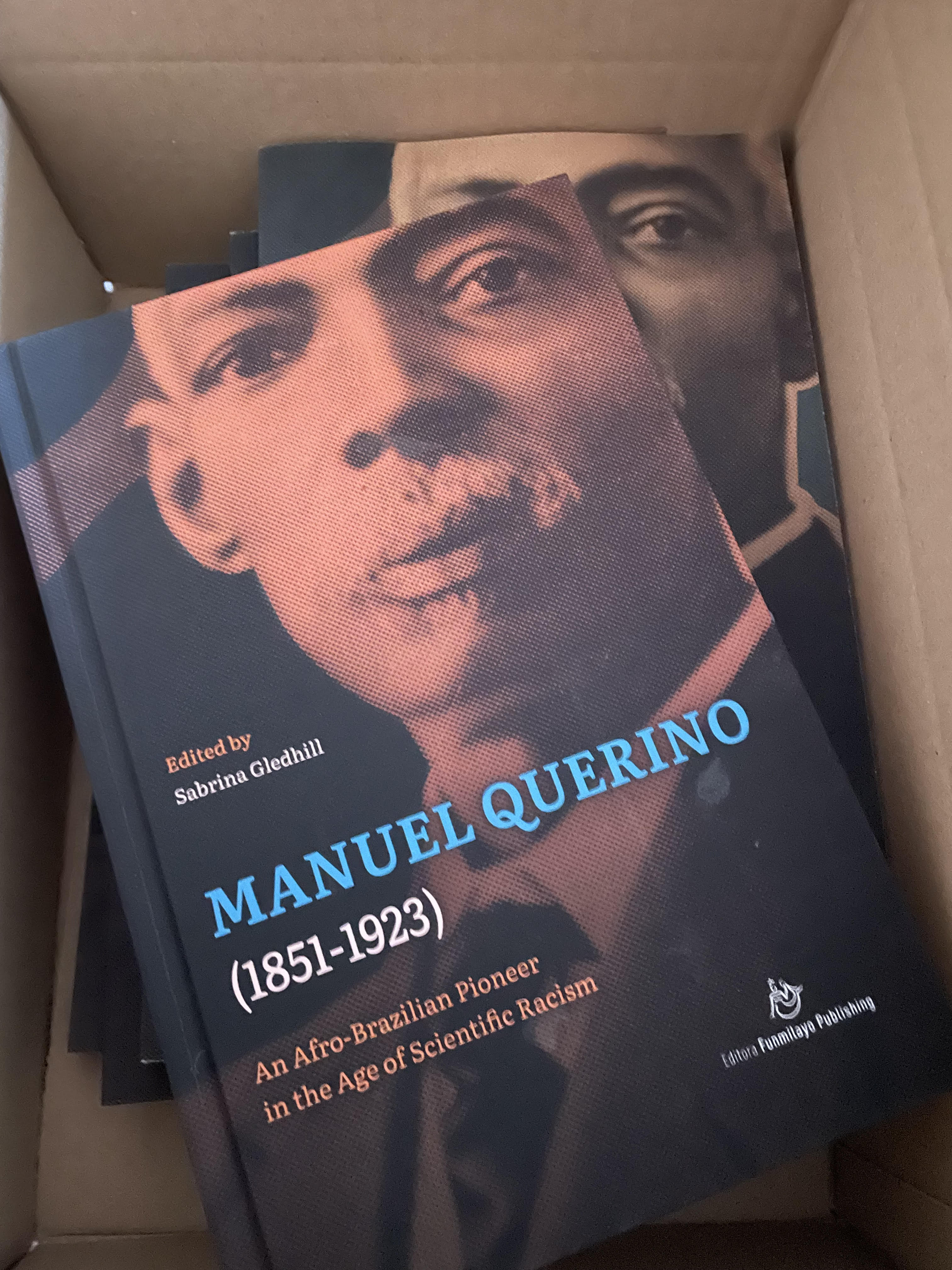
Manuel Querino (1851–1923): An Afro-Brazilian Pioneer in the Age of Scientific Racism. Edited by Sabrina Gledhill. Crediton, UK: Editora Funmilayo Publishing, 2021. Photographs. Figures. Appendix. Notes. Bibliographies. xxi, 196 pp. Paper, $9.99.
For a long time, Manuel Querino was yet another Black intellectual who was overlooked by history. Yet, a still-incipient movement to bring Black intellectuals’ output to light has favoured his appreciation and recognition. This may be the greatest merit of the book Manuel Querino (1851–1923): An Afro-Brazilian Pioneer in the Age of Scientific Racism.
Besides the author herself, six other scholars take part in this work, which includes a total of nine essays that cover various aspects of Manuel Querino’s activities: the artist, the abolitionist and labour activist, as well as the politician, and finally, the scholar.
Manuel Querino was born in July 1851 in the town of Santo Amaro in the Recôncavo Baiano [the bay area of the Brazilian state of Bahia], the son of a Black couple who were born free in Brazil during slave times. Described by some authors as a “mulatto,” the fact is that, when he was born, negro was synonymous with enslaved, and preto with African. Thus, he lived through two important periods in Brazil: slavery and post-abolition. As a child, he went to the capital of Bahia to grow up in the care of a guardian. Querino was a painter, decorator, and teacher of geometric drawing. When he returned from the Triple Alliance War in 1871, he got deeply involved in labour and abolitionist activism. Then he went even further, taking public office in the city of Salvador from 1890 to 1891, and at a later stage, from 1897 to 1899, when he concluded his public service as a city councillor.
These biographical details are repeatedly presented in Manuel Querino. They initially appear in Gledhill’s introduction and are further explored in the first essay, by E. Bradford Burns, and the third, “Journalist and Politician,” by Jorge Calmon, in which it becomes clear that Querino was responding to theories of racial inferiority by demanding access to education, better working conditions, and the abolition of slavery. In fact, it was Querino’s intellectual output during the era of scientific racism that, even before Gilberto Freye, rebutted contemporary theories about the degeneration of the population caused by racial mixture, and the racial inferiority of the Black population.
Querino’s solitary struggle against the intellectual elite of his time is also the topic of the second chapter, “From Soldiers to Scholars: Manuel Querino’s Contribution to Black Vindicationism,” by Sabrina Gledhill. In that essay, the author points to the very nature of Querino’s theories as the reason for his erasure from the field of scholarship, being at most recognised as a folklorist, informant, and collector, but not as an intellectual, despite his research. In the fourth chapter, Gledhill returns to the subject of Querino’s activism, but this time as a labour leader during slave times. Furthermore, his commitment to the abolitionist movement, which, like his work, is barely known, shows how his activism deviated from the standards of elite abolitionism.
In the fifth chapter, “First Historian of Bahian Art,” Eliane Nunes addresses Querino’s relationship with the arts, both as an artist and scholar. The author argues that it was more as a researcher of the arts, and not necessarily as an artist, that Querino made his greatest contributions, particularly due to his effort to bring Black artists out of obscurity. Nunes also brings up another issue: the fact that, in his book Artistas bahianos (Bahian Artists), published in 1909, the racial identity of Black artists is not disclosed, something he would only do nearly a decade later. I believe that Querino may have used another method to achieve the same end; that is, he first sought to value the achievements of the people he studied, before revealing their racial identity.
As a way of confronting the scientific racism of his time, Manuel Querino also innovated by making different use of photographs of African people. According to the author of the sixth chapter, Christianne Vasconcellos, by turning to images as a source of historical research, this intellectual used photographs of African men and women to show the diversity of the ethnic groups that lived in Bahia, besides affirming the sophistication of the sacred garments worn by the women of the African-based religion, Candomblé. This feeling of appreciation and value for Bahia’s African cultural heritage reappears in the eighth chapter, by Jeferson Bacelar and Carlos Alberto Dória, “Creator of Bahian Folk Cuisine,” which demonstrates how Querino used Bahian cuisine as a metaphor for the formation of Brazil’s national culture. Thus, he once again demonstrated how Africans ended up producing a different, specific and, therefore, Afro-Bahian cuisine.
The book concludes with another essay by the editor, Sabrina Gledhill–“Reflections on Portraits of Manuel Querino”–which discusses the subliminal meanings of photographic portraits of Querino. Produced in the early twentieth century, these photographs were used in posthumous tributes, and show Querino’s concern with defining himself through photography. This was common in the Black diaspora, as, when it was within their means, men and women sought to construct a photographic memory for themselves as proud, free individuals endowed with courage, respectability, and intellectual authority. For the author, the portrait of this intellectual displayed in the gallery of honour of the Geographical and Historical Institute of Bahia (IGHB) in 1928 is an example of that sentiment.
Thus, through Manuel Querino, we can get a broad idea of the thinking of one of Brazil’s greatest intellectuals. Signs of his keen perceptions as an Afro-Bahian scientist become clear in his choices, methods, and careful look at an Afro-Brazilian Brazil. What seems obvious to us today was, in his time, his greatest field of activism.
Luciana Brito, “Manuel Querino (1851-1923): An Afro-Brazilian Pioneer in the Age of Scientific Racism,” in Hispanic American Historical Review vol. 104, no. 3, pp. 525-527. Copyright 2024, Duke University Press. All rights reserved. Republished and translated by permission of the copyright holder, and the Publisher.
doi 10.1215/00182168-11189722
Translated by Sabrina Gledhill
“Forefather of Affirmative Action”
Marcos Rodrigues
MA in Ethnic and African Studies, UFBA
ORCID: 0000 0002-6662-2350
Review of GLEDHILL, Sabrina (ed.). Manuel Querino (1851-1923): An Afro-Brazilian Pioneer in the Age of Scientific Racism. Crediton: Funmilayo, 2021.[1]
Edited by the independent scholar Sabrina Gledhill, this book introduces—or reintroduces—the life and work of the Brazilian intellectual and activist Manuel Querino (1851-1923), a pioneer in the construction of the civilizing Afro-Brazilian discourse in the age of scientific racism. Born in Santo Amaro, Bahia, in colonial times, Querino can certainly be considered the forefather of the struggle for affirmative action for the Black population, based on the spaces he occupied as an educator, labour leader, politician, ethnologist, and writer.
It was a time when evolutionist theories affirmed the classification of inferiority and the prospect of extinction for the Black population, favouring European immigration and the culture of “whitening.” Manuel Querino emerged as a pioneer in several advanced lines of thought, such as ethnology, food anthropology, art history, and the struggle for affirmative action. These qualities marked his trajectory in this book, which also includes essays by E. Bradford Burns, Jorge Calmon, Eliane Nunes, Cristianne Vasconcellos, Jeferson Bacelar, and Carlos Dória.
With the aim of presenting a many-sided biographical analysis against a framework of concepts and definitions of blackness from an evolutionary standpoint, this book was organised from the perspective of scholars from the fields of politics, history, anthropology and social science who focussed on shedding light on Manuel Querino’s legacy. This anthology is also the result of the interconnected movement of humanists from different generations, which certainly contributes in grand style to the reintroduction of its protagonist and his multifaceted trajectory.
Constructing a discourse involves transgressing, deconstructing, and selecting the paradigm or category of thought to be followed. This foray by Sabrina Gledhill dates back to her previous book, Travessias no Atlântico Negro: Reflexões sobre Booker T. Washington e Manuel Querino (Black Atlantic Crossings: Reflections on Booker T. Washington and Manuel R. Querino; Edufba, 2020), and her participation in other edited volumes, with the aim of spotlighting activist intellectuals from the world of the African diaspora. Now, very opportunely, she has written essays and linked them to narratives by other authors to help establish Manuel Querino’s rightful place as a political subject of his time, whose leading role must be explored.
But what is the place which Manuel Querino occupies in the history of the Brazilian arts and culture, specifically in the state of Bahia? Certainly, in this book, there are several clues to follow to obtain an answer from each author’s perspective. In every field of activity, Querino produced a work that has left its mark on our time. Although he was never enslaved, he seems to have constructed a public discourse based on the perspective of Black people in a society that was being transformed after losing its economic foundations, the culture of bondage.
In her introduction, Sabrina Gledhill, a British Brazilianist and award-winning translator educated in the UK, the US, and Brazil, reveals that her interest in Querino began in the early 1980s, when she was looking for a subject for her MA research at UCLA. Putting Manuel Querino’s life and work in context, she keeps a close eye on the path followed by a controversial man who experienced the final phase of the colonial era and the consequences of slavery in the early twentieth century. The author and editor describes Querino as a lone voice, a Black man who won a place among the White elite and tried to use his position to spread a message that few people of his colour could or were willing to deliver.
Few Brazilians followed such an enlightened path as Manuel Querino, now reintroduced to all those who work in the field of social science and are still surprised when he is mentioned. The importance of revitalising this memory comes from his being a pioneer in the fight against scientific racism as dictated by forensic medicine, from underscoring the African influence in Brazilian history, from introducing the field of art history in Bahia, as well as research on the anthropology of food.
Of the nine chapters that make up this book, two, in particular, stand out. Chapter 6, which focuses on the use of photographs in ethnographic studies, is a direct reflection on a debate that is now actively ongoing in anthropology. The author, Christianne Vasconcellos, sheds light on Manuel Querino’s anthropology in his ethnographic studies of Africans in Bahia with an essay that induces the reader to return to the path of recognising and knowing him as a way of understanding our historic process.
Chapter 8 is the key to understanding the origins of what is now known as Bahian cuisine. The scholars and guest authors Jeferson Bacelar and Carlos Dória reveal that Manuel Querino was the first to study Bahian cuisine, giving rise to a segment of food anthropology. Thus, it should be recalled that the tourist attraction now promoted on a grand scale came from the research done by Querino in difficult times marked by a strictly Eurocentric culture in a colonising intellectual market.
Reading that essay easily leads us to reflect on how the African diaspora in the Americas and Caribbean contains thousands of hidden human values that struggled and played a leading role in overcoming adversity, and the effectiveness of post-slavery affirmative action. The civilising discourse that shaped our thinking, always on the basis of European colonisers as a tentacular reinforcement for scientific racism, was already showing its contradictions. Hence, the merit of the narratives gathered here in delving against the grain of invisibility and bringing to light the life and works of Manuel Querino.
This anthology seems to achieve an important goal. It leaves the reader wanting to find or re-examine Manuel Querino’s work and include him among the main sources in discussions or research that will be forthcoming when the topic is Bahian culture. The objectivity of the essays leads to a sphere of knowledge hitherto neglected by the canonical thought of the intellectual “classics” of the past. Thus, recent generations are grateful for this act of reparation on behalf of a vibrant historical and cultural legacy that is clearly overlooked.
Certainly, digging into Querino’s life is no easy task for scientific research. The sources consulted and the authors invited to take part in this publication show the extent of the activity surrounding a personage who paved the way for ethnological, historical, and artistic studies focused on Africanity and its offshoots in the diaspora. Thus, this book is also an example of intellectual responsibility.
[1] Adapted from a review of the Brazilian edition. Translated by Sabrina Gledhill
 Editora Funmilayo Publishing