Black Atlantic Crossings: The Lives and Anti-Racist Tactics of Booker T. Washington and Manuel R. Querino

Black Atlantic Crossings by Sabrina Gledhill examines the lives and anti-racist tactics of Booker T. Washington and Manuel R. Querino, two influential figures in the Black Atlantic world whose contributions have often been overlooked or belittled. Challenging this historical erasure, the book argues that these figures were not merely products of their respective national contexts (the United States and Brazil) but rather transatlantic intellectuals who navigated and challenged the racialised boundaries of their time. It emphasises the interconnectedness of Black experiences and intellectual movements across the Atlantic, highlighting how Washington and Querino, despite their geographical distance, shared common concerns and engaged in vital transnational dialogues. Furthermore, it analyses the strategies and tactics they employed to combat racism and promote social justice within their societies, including their engagement with education, politics, and cultural production, ultimately offering a crucial rethinking of their lives, work, and enduring impact beyond narrow nationalistic frameworks.

The latest addition to Funmilayo’s Unsung Heroes series, Black Atlantic Crossings is now available in full-colour and black-and-white editions. You can find it on all major online booksellers, including Amazon and Waterstones.

Praise for Black Atlantic Crossings
As promised, Sabrina Gledhill’s research does, in fact, expand the Black Atlantic by putting into dialogue the ideas and activism of two giants of the African Diaspora in the Americas. The legacy of Booker T. Washington has been well known, including in Brazil, since the turn of the twentieth century. However, in addition to reinterpreting his legacy in a broader context, this book introduces the English-speaking reader to Manuel Querino, an insightful and multifaceted Afro-Brazilian thinker who is little known outside Brazil. Enjoy reading this original work, which is destined to become a classic.
João José Reis, Universidade Federal da Bahia, author of Slave Rebellion in Brazil

Black Atlantic Crossings is a timely reflection on the challenges that African American intellectuals faced in the aftermaths of slavery in Brazil and the United States. While not always understood or accepted by later commentators, the anti-racist activism of Manoel Raimundo Querino and Booker T. Washington, ably analyzed by Sabrina Gledhill, profoundly challenged the emerging post-slavery hierarchies. She demonstrates that there is much to learn from these two men’s lives and the evolution of their historical memory in the century since their deaths.
Hendrik Kraay, University of Calgary, author of Bahia’s Independence: Popular Politics and Patriotic Festival in Salvador, Brazil, 1824-1900

Crossing the Atlantic requires navigating a sea of stories through rough and calm waters, amidst fleeting encounters and enduring dialogues. In this insightful work, Sabrina Gledhill offers more than just a theoretical compass. Her sophisticated approach reveals the profound oceanic connections that shaped Booker T. Washington and Manuel R. Querino, revisiting them as original Atlantic characters, without borders, but with transnational margins.
Flavio dos Santos Gomes, Universidade Federal do Rio de Janeiro, co-author of The Story of Rufino: Slavery, Freedom, and Islam in the Black Atlantic
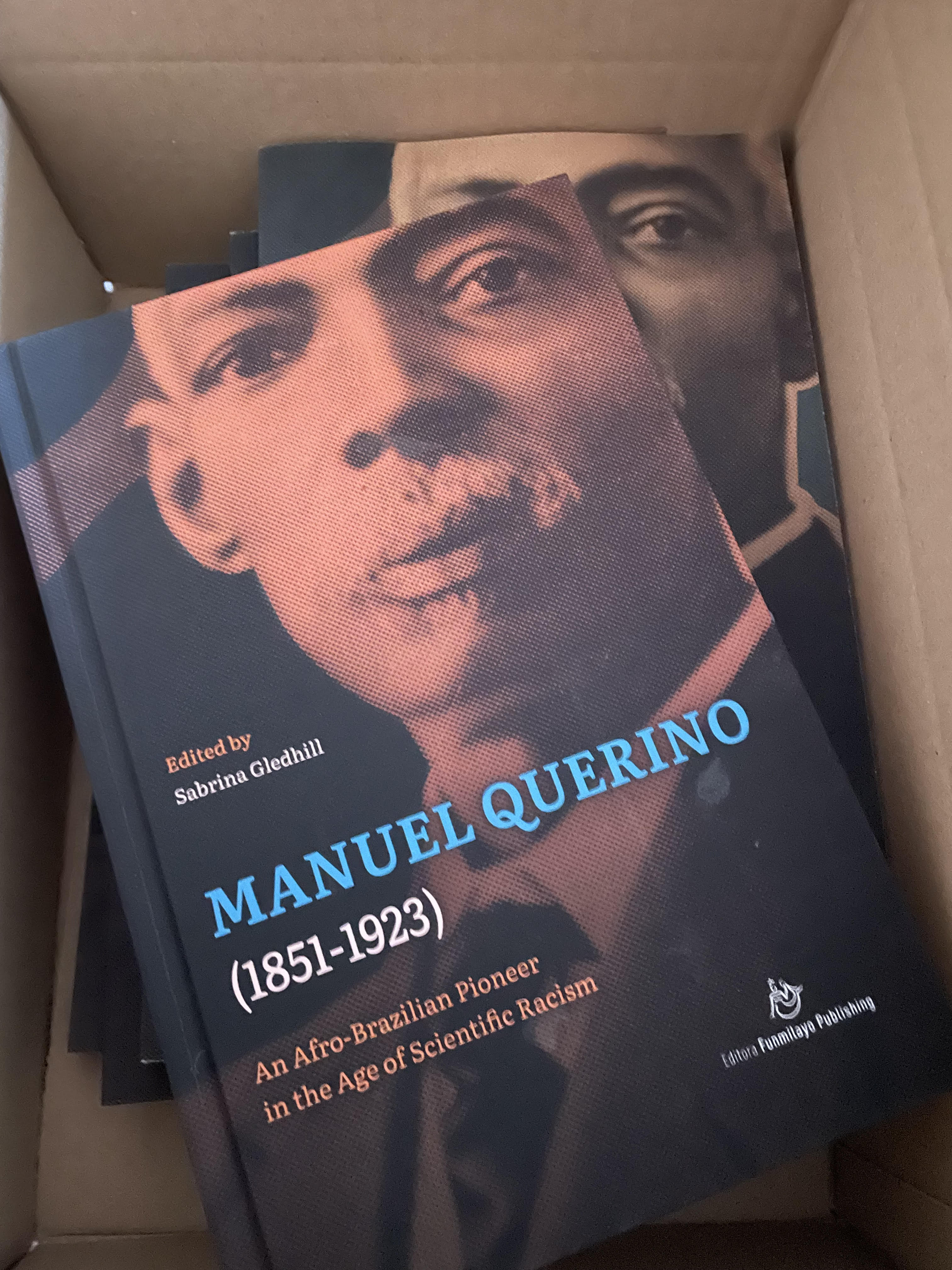
Manuel Querino: Activism and Education for Freed-persons

On 13 May 1888, the “Golden Law” officially abolished slavery in Brazil – the last country in the Americas to do so. For abolitionists like Manuel Querino, it was a huge achievement. The following year, a coup overthrew the monarchy, exiled Pedro II and his family – including Princess Isabel, the signatory of the “Golden Law” – and established the First Republic. As a life-long republican, Querino must have felt that this, too, was a dream come true, the outcome of many hard-fought struggles. Unfortunately for him and, even more so, the people recently emancipated from slavery, the new republic did not represent a step forward for Black people or their culture. Instead, it viewed Afro-Brazilian culture as “backward” and many of its expressions were criminalised, including candomblé and capoeira. Worse, the new government defunded or closed schools that had once provided vocational and higher education that would have been accessible to the poor, including those whose emancipation brought no reparations. Querino was aware of this, protested it and even felt the consequences.

Because of all the difficulties, obstacles and challenges freed-persons faced during the post-Abolition period, 13 May has become a controversial date for Black activists and their allies. Is it really something to celebrate? Today, November is Brazil’s Black History Month. Black Consciousness Day is celebrated on 20 November, the date when Zumbi dos Palmares, the last leader of possibly the oldest and certainly the best known quilombo or maroon community, was betrayed and killed.

Despite the controversy, I am sure that Querino and many Black activists like him would have celebrated 13 May in his day as a major milestone in Brazilian history – one that he personally worked hard to achieve as a militant journalist and activist.

To learn more about Querino’s fight against racism and support for the education of freed-persons, read Black Atlantic Crossings and Manuel Querino (1851-1923), available on Amazon and other online booksellers.

‘Freeing’ a modern-day slave (part two)

breaking chainsAs I wrote in part one, I like to think that I freed a slave – a young girl who was being forced to work as a maid for no pay in Brazil – but looking back, I realised that she was, in her own way, a free agent…

Although this story could have taken place today, it happened nearly twenty years ago. I was helping organise the first PercPan percussion festival in Salvador’s Castro Alves Theatre, and had to spend a few nights at the nearby Hotel da Bahia (now the Sheraton). Whilst there, I invited my daughters and Bela over to the hotel to enjoy the pool. I noticed (or was told) that Bela spent most of her time talking to the hotel manager’s son, who was about her age. I thought nothing of it. The next day, I rang home to see if anyone wanted to stay at the hotel whilst I was working (I usually got back at about 2 am). Bela answered the phone and pipped my daughters at the post, eagerly accepting the invitation. Again, I thought nothing of it. When I got back from work at the usual time, I knocked on the hotel room door and no one answered. I thought Bela must be asleep, so I went down to the lobby and rang the room (I only had one key and had left it with her). No answer. Unable to get into my room and not knowing where Bela was or what she was doing, I decided to take the lift to the penthouse and say good-night to my boss, thought better of it when I reached the 10th floor, and headed back down the staircase. There, in the stairwell, I found Bela in a clinch with the hotel manager’s son!

As a result of that and other indications, I began to worry that Bela was trying to use her youthful sexual charms to get a leg up in life. I feared that if she stayed in the ‘big city’ she would finish up as a prostitute, so I purchased a bus ticket to her home town and sent her back to her mother with a small amount of cash to tide her over. She rang me when she arrived to say she had ‘lost’ the money and I commiserated, but didn’t offer any more.

It turns out that I was right about Bela’s use of her sexuality, but she did so within the legal smokescreen of marriage. She accepted a much older suitor who had been pursuing her before she moved to Salvador (yes, she was still underage) and eventually came to own a chain of beauty parlours. Either divorced or widowed, she went on to marry a doctor who was closer to her age, and as far as I know, she is still happily married and a successful businesswoman to boot.

Did I ‘rescue’ Bela or was I merely a pawn in her gambit for freedom? I don’t believe I would have done anything differently, either way. Also, I can’t help wondering how many other young women are still enduring a similar situation but cannot find a ‘saviour’ – or save themselves.

‘Freeing’ a modern-day slave (part one)

breaking chains I like to think that I freed a slave – a young girl who was being forced to work as a maid for no pay in Brazil – but looking back, I realised that she was, in her own way, a free agent…

The regulations governing domestic service in Brazil have changed dramatically in recent years, giving maids and nannies nearly all the rights provided to officially employed workers under the country’s draconian labour laws. Their most recent achievement is the right to the Length-of-Service Guarantee Fund (FGTS). Unfortunately, as householders find themselves having to pay their servants the minimum salary plus benefits, and the tax burden rises, many are no longer able to afford full-time, live-in help and are adopting a system more common in the ‘First World’ – having cleaners come by twice a week at most, to avoid the risk of being sued for failing to sign their work papers.

One way of getting around this is bringing in a young girl from the countryside to work as a maid in exchange for an education. Sometimes the bargain is honoured. In many cases, she becomes a modern-day slave.

My elder daughter befriended one such domestic worker, a fourteen-year-old girl I’ll call Bela. She worked for a couple that lived in the flat above ours. Through my daughter, I would hear that, although Bela was allowed to study, her activities were being increasingly curtailed. After a while, she was only allowed to leave the flat to go to the bakery, and made to work every day of the week, including Sunday, when she did the ironing.

Another sad fact about Brazilian maids is that they are often subjected to sexual harassment. I gathered from the news that filtered through my daughter that this underage girl was being sexually stalked by the man of the house. His jealousy might be the reason for her virtual house arrest, as she was even accused of flirting with the baker!

Even worse – again, according to Bela – she did not receive any money directly. The couple claimed to be depositing her wages in a savings account in Bela’s home town, but there was no proof that this was actually the case.

One weekend, I was taking my family with me on a scouting mission to organise a tour of the region for architects who would be planning a resort on the North Coast of Bahia, and invited Bela to go along. My daughter wanted her to go with us to keep her company, and I felt sorry for her, as she was rarely allowed to cross the street, let alone go on a day trip into the countryside. Bela agreed with alacrity, and we all had a good time visiting the colonial landmarks and resorts I selected for the architects’ itinerary.

When we got back, I was startled to hear Bela say that she could not return to her home/workplace because she had left without permission. She seemed fearful of the consequences. I immediately offered to let her stay with us, and she accepted. My daughter was pleased and I thought I had done a good deed. Then things got complicated…