O livro Travessias no Atlântico Negro, reflexões sobre Booker T. Washington e Manuel R. Querino está disponível pelo preço promocional de R$4,99 até amanhã (3 de setembro de 2018). O valor normal é R$34,99. Promoção válida apenas no Brasil, nos sites da Amazon – http://www.amazon.com.br (Kindle) – e da Livraria Cultura – http://www.livrariacultura.com.br (Kobo)
De/visualizing Blackness
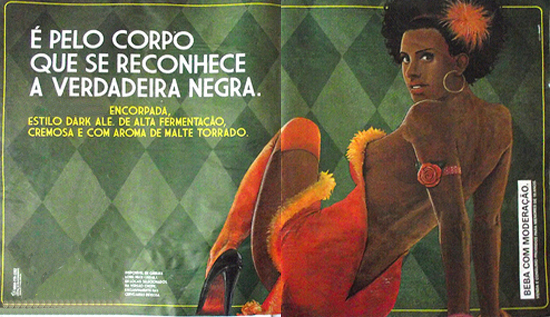
Condemned as racist and exploitative of black women, this controversial advert for Devassa dark beer did something far worse
Last week, I attended a thought-provoking seminar, ‘Visualizing Blackness in Latin America & the Caribbean, 16th-19th Centuries‘, held on 29 & 30 May 2018, and organised by the Institute of Latin American Studies, School of Advanced Study, London. Among many other interesting topics, in her keynote lecture, “Colour and Undertones: On Black Subjects in Latin-American Visual Culture”, Dr Tamara J. Walker mentioned an advert for Devassa dark beer which sparked controversy in Brazil a few years ago. In 2012, the National Council for Self-Regulation in Advertising (Conar) determined that the makers of Devassa – a product line that also includes a ‘blonde’ beer, and whose name is defined as ‘woman devoid of modesty or morals with regard to sex’, which could be translated as ‘slag’, ‘slut’ or worse – had to change the advert, as it was considered racist, a crime under Brazilian law.
When I saw the advert again after all these years, something else struck me about the image. Everyone at the seminar agreed that the woman portrayed is lovely and sexy in the old-fashioned pin-up style of glamour. The racism is more to be found in the text, which reads: ‘you can tell a true black woman [dark beer] by her [its] body’ (as the word for beer is feminine in Portuguese, this sort of double entendre is easily conveyed).
The main problem I saw with the image was that, according to Brazilian racial categories, the woman portrayed is not ‘black’ at all, but the classic sexualised and romanticised ‘mulata’ (once known in English as a ‘mulattress’). In other words, the text of the advert is not only racist and sexist, but the image has failed to represent black women as presumably intended – thereby effectively de/visualizing them and deleting them from the picture.
I had some difficulty explaining this to an African-American scholar, presumably because the one-drop rule in the US has led to greater solidarity and unified self-identification among a relatively small portion of the population, based on ancestry and the common experience of historical enslavement (as I argue in my PhD thesis, President Obama was only legitimised as a representative of the African-American community by his wife, Michelle, as his father came directly from Africa and therefore did not share that experience of historical enslavement), whereas in Brazil, African ancestry is so widespread that many people who would be considered black elsewhere see themselves as white or ‘brown’ (pardo). As a result, ‘blackness’ is based on appearance and placed at one extreme of a continuum, the other end of which is ‘whiteness’. There are many shades and categories in between.
In Brazil, ‘race’ is identified not through ancestry but through markers – particularly skin colour, features and hair. Although she has full lips – de rigueur among models and actresses of any ethnicity nowadays – the features of the woman in the advert are European and considered attractive according to the white racialist aesthetic, particularly her nose. Even among the very few black women who make it into the modelling world in Brazil, there is a distinct preference for those with a ‘nariz afinada’ – an aquiline or Roman nose. This is nothing new, as racialist discourse has long given preference to such noses, seeing them as superior to ‘snub’ or ‘broad/flat’ breathing apparatus (N.B. by way of full disclosure, I have a ‘snub’ or ‘retroussé’ nose, and although, as far as I am aware, I am ‘white’, a white supremacist once told me that I could be black, based on the shape of my nose and lips).
As I pointed out to my African-American interlocutor – and I hope I made clear then and now – I am not denying that the fictional woman portrayed could, and probably would, self-identify as black in Brazil. I am not negating her self-perceived Blackness. The problem with the picture is that, to be truly ‘black’ by Brazilian lights – especially in Bahia – she should look more like Zezé Mota or Taís Araújo. Better yet, to mention a more familiar example for non-Brazilians, she should strongly resemble Lupita Nyong’o.
Apologies, and moving on
I apologize for the last few posts, publicising my new e-book in Portuguese. I am working on an English translation, adapted for a non-Brazilian readership. I have changed the name of this blog to encompass other topics that might arise. I have recently noticed, for example, that the debate on the supposed Booker T. Washington/W.E.B. Du Bois dichotomy is still alive and well, and intend to weigh into it shortly. Watch this space!
Travessias no Atlântico Negro, agora no Kindle brasileiro
Travessias no Atlântico Negro: Reflexões sobre Booker T. Washington e Manuel R. Querino está disponível no Kindle brasileiro. Veja uma amostra.
Travessias no Atlântico Negro já está disponível
Meu e-book Travessias no Atlântico Negro: Reflexões sobre Booker T. Washington e Manuel R. Querino já está disponível no site da Livraria Cultura.
Neste livro, Sabrina Gledhill analisa as trajetórias e táticas antirracialistas de Booker T. Washington (1856/1915) e Manuel Raymundo Querino (1851/1923), dentro do contexto do Atlântico Negro. Apesar do prestígio que desfrutaram em vida, suas imagens foram dilapidadas após a morte: Washington com a mácula de “comodista” e até “traidor da raça”; e Querino com a imagem de um “humilde professor negro” de parcos poderes intelectuais. A realidade, como os dois educadores negros que são o enfoque deste trabalho, foi muito mais complexa.
Querino foi uma fig ura multifacetada: pintor-decorador, artista, abolicionista, jornalista, líder operário, político, professor de desenho industrial e pesquisador, fundador da historiografia da arte baiana, defensor dos terreiros de candomblé, sócio fundador do Instituto Geográfico e Histórico da Bahia, inspiração para Pedro Archanjo (protagonista de Tenda dos Milagres) e o primeiro intelectual afrobrasileiro a destacar a contribuição do africano à civilização brasileira.
Educador, orador e conselheiro de presidentes dos Estados Unidos, Washington nasceu escravo e chegou a ser considerado o “negro mais famoso do mundo”. Após a Emancipação, trabalhou como zelador para custear seus estudos no Instituto Hampton, fundou o Instituto Normal e Industrial Tuskegee e tornou-se o líder da “nação negra” nos Estados Unidos, tendo como seu maior rival o intelectual negro W.E.B. Du Bois.
Depois de apresentar o contexto em que viveram e traçar as interconexões entre suas realidades, Gledhill analisa suas trajetórias durante a vida e após a morte. Mostra como Manuel Querino poderia ter acesso a informações detalhadas sobre a vida e obra de Washington décadas antes que sua autobiografia mais conhecida, Up from Slavery, fosse lançada no Brasil, traduzida por Graciliano Ramos. Paul Gilroy, o idealizador do conceito do Atlântico Negro, usa a metáfora de navios atravessando o oceano. Gledhill mostra que as “travessias” também poderiam ser realizadas por meio de traduções e da telegrafia.
Novo e-book no prelo
A “Brazilian” in Blighty

Photo by wynand van niekerk
When I used to visit the UK while living in Brazil, I sometimes found myself doing what I would do in Bahia – like slapping the side of a London bus that was pulling away from the stop in hopes that it would let me on (not a chance, and I found myself stared at). Now that I live here, I am becoming rapidly acculturated. I even think 14 degrees (Celsius) is mild! However, a recent experience has shown that I haven’t stopped being (or acting) Brazilian in Blighty.
When my daughter was visiting me in Birmingham, we went out for an Indian meal with an old friend who wanted to meet her. My friend had advised me to use a particular car park, so when we got there I pulled out the ticket as the gate spat it out, and popped it under the windscreen. I think. As we were walking away from the car, I realised that it wasn’t a “pay and display” but a “walk and pay” system, so I went back for the ticket. It was nowhere to be found. Neither my daughter nor I could remember what I’d done with it after I pulled it from the gate, although I was sure I had stuck it under the windscreen. We tore the car apart. No ticket to be seen. Finally, I resigned myself to paying the full fee – about £16 – and we walked glumly to the restaurant to meet up with my friend.
Hours later, cheered by a varied and not-too-pricey meal at Jimmy Spices, the three of us returned to the car park. While my daughter went back to the car to make a last-ditch effort to retrieve the *&(£$% ticket, my friend and I tried to find someone I could pay to let us leave. The glassed-in office was dark and empty, and for a moment I thought we would be there all night, but then I noticed a light gleaming through a crack in an inner door. Instinct took over and I suddenly slapped on the glass. Instantly, a man sprang out and opened the outer door to see what the fuss was about. “My ticket has vanished!” I cried with all the scene-chewing passion of a Brazilian soap star. “Here, take this,” he blurted, handing me a ticket. “It’ll let you out.” I was confused at first. How much would I have to pay? I tried to validate the ticket but the machine refused to recognise its existence. Finally, I decided to take a chance, said good-night to my friend and drove up to the barrier. The ticket went in, the barrier went up, and my daughter and I drove through. Free of charge. When I told my friend he couldn’t believe it. I still can’t. I wouldn’t try it again.
‘Freeing’ a modern-day slave (part two)
 As I wrote in part one, I like to think that I freed a slave – a young girl who was being forced to work as a maid for no pay in Brazil – but looking back, I realised that she was, in her own way, a free agent…
Although this story could have taken place today, it happened nearly twenty years ago. I was helping organise the first PercPan percussion festival in Salvador’s Castro Alves Theatre, and had to spend a few nights at the nearby Hotel da Bahia (now the Sheraton). Whilst there, I invited my daughters and Bela over to the hotel to enjoy the pool. I noticed (or was told) that Bela spent most of her time talking to the hotel manager’s son, who was about her age. I thought nothing of it. The next day, I rang home to see if anyone wanted to stay at the hotel whilst I was working (I usually got back at about 2 am). Bela answered the phone and pipped my daughters at the post, eagerly accepting the invitation. Again, I thought nothing of it. When I got back from work at the usual time, I knocked on the hotel room door and no one answered. I thought Bela must be asleep, so I went down to the lobby and rang the room (I only had one key and had left it with her). No answer. Unable to get into my room and not knowing where Bela was or what she was doing, I decided to take the lift to the penthouse and say good-night to my boss, thought better of it when I reached the 10th floor, and headed back down the staircase. There, in the stairwell, I found Bela in a clinch with the hotel manager’s son!
As a result of that and other indications, I began to worry that Bela was trying to use her youthful sexual charms to get a leg up in life. I feared that if she stayed in the ‘big city’ she would finish up as a prostitute, so I purchased a bus ticket to her home town and sent her back to her mother with a small amount of cash to tide her over. She rang me when she arrived to say she had ‘lost’ the money and I commiserated, but didn’t offer any more.
It turns out that I was right about Bela’s use of her sexuality, but she did so within the legal smokescreen of marriage. She accepted a much older suitor who had been pursuing her before she moved to Salvador (yes, she was still underage) and eventually came to own a chain of beauty parlours. Either divorced or widowed, she went on to marry a doctor who was closer to her age, and as far as I know, she is still happily married and a successful businesswoman to boot.
Did I ‘rescue’ Bela or was I merely a pawn in her gambit for freedom? I don’t believe I would have done anything differently, either way. Also, I can’t help wondering how many other young women are still enduring a similar situation but cannot find a ‘saviour’ – or save themselves.
Short stories in Portuguese
New Year’s Resolution in 2016: taking myself more seriously as a writer (in English and Portuguese)

Looking back on 2015: A disturbing trend in Brazil
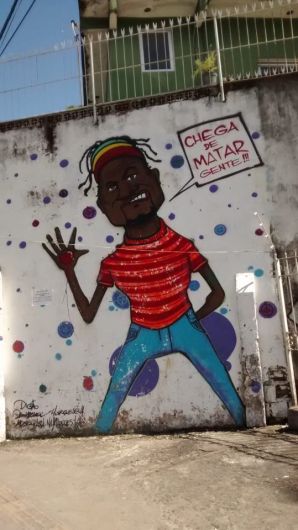
Graffiti artists’ protest against the Cabula massacre, seen in that district in 2015. Photo by Sabrina Gledhill (all rights reserved)
On 6 February, 2015, policemen shot and killed 12 robbery suspects in the Cabula district of Salvador, Bahia. An internal investigation by state’s Public Prosecutor’s office found that the victims – all of them young black men – had been executed. The black movement calls it genocide, a disturbing trend in a country where racism has traditionally been veiled and racially motivated lynching almost unheard of. That being said, exterminating street children (the best-known incident being the Candelaria massacre in Rio in 1993) and known or suspected criminals as if they were vermin is nothing new in Brazil. Ironically, there is no official death penalty in that country.
***
The graffiti art in the photo illustrating this post was not the only response to the Cabula massacre by the Bahian arts community. From May to August 2015, the Museu Afro-Brasileiro (MAFRO) held an exhibition curated by the museum’s director, Graça Teixeira that displayed thought-provoking installations and artworks protesting the genocide of black youth in Brazil.
 Editora Funmilayo Publishing