Water Shortage (not what you’d think)

Parts of Brazil, including the state of Bahia (which is the size of France) are experiencing a ‘water crisis’. Fortunately Cabula, the working-class-gentrifying neighbourhood where I’ve lived since March, has not even suffered the temporary shortages caused by ‘improvements’ to the supply system. However, there is one drama I had never experienced before – having to possess the right kind of bottle, and one that is within its ‘best by’ date, in order to purchase mineral water. This is because tap water is undrinkable and I don’t trust ozone filters. Clay filters are supposed to be best, but they take up too much space and are hard to clean. So for years now, I’ve purchased large bottles of mineral water and so far, I’ve had no problems – until this afternoon. Starting with the fact that, in order to buy just the water and not the container, one has to have ’empties’ to hand over in return. But that’s not all!

clay filter

Back to Clay Filters?

It all started when I decided to purchase water from the cheaper of two suppliers – simple market logic, you’d think? More like penny wise, pound foolish! When the cheaper supplier (Supplier T) was out of stock, I turned to the other one (Supplier I) and found that they only sold the pricier ‘crystal’ plastic bottles and would only replace them with others of the same type. And when I managed to claw them back from Supplier T, who had replaced them with the cheaper kind, the bottles turned out to have ‘expired’ – that is, they were too close to the end of their expiration date to be acceptable for Supplier I.

Today I found that Supplier T has suddenly stopped selling water altogether, when they still owed me two ‘crystal’ containers (probably out of date, but still the type I need to get the better brand of water). I had to pay Supplier I for two ‘crystal’ containers plus the water – nearly three times more than what I would normally have to pay. At least it’s an investment – as long as no one in my household allows another supplier to swap them out for the cheap kind. When I explained the situation to Supplier I, she said “You were buying from Supplier T, weren’t you?” Lesson learned.

World Cup reflections

As usual, a highly publicised international event has arrived in my city and I’m watching it on television. Salvador’s Fonte Nova stadium has seen dramatic games and a torrent of goals. That’s likely to dry up (Fonte Nova means New Fountain in Portuguese, hence the pun) in the quarter-finals, if the round of 16 is anything to go by.

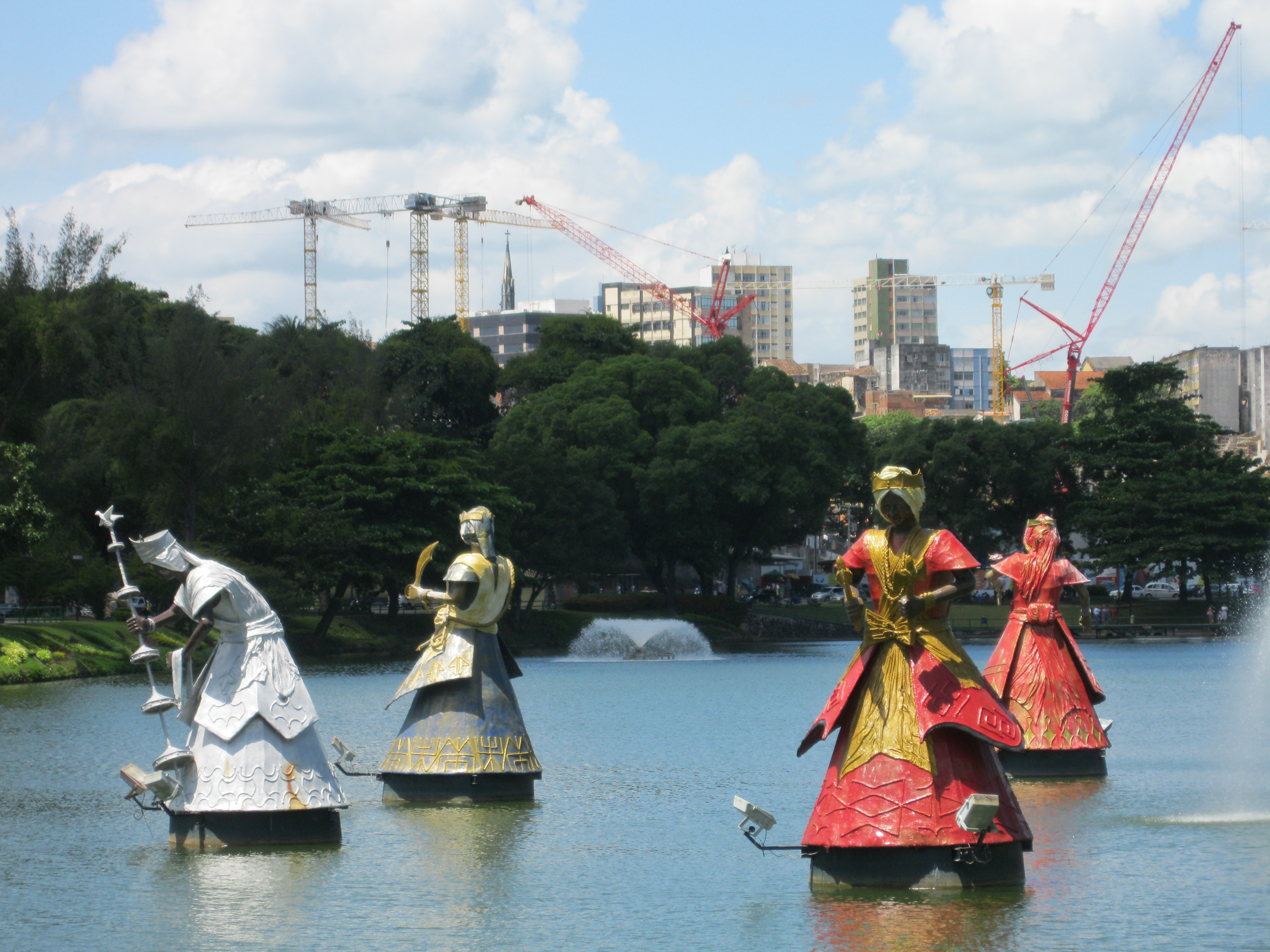
Orisha statues by Tatti Moreno (photo: Sabrina Gledhill, 2012)

Dique do Tororó with the stadium under construction in the background (photo: Sabrina Gledhill, 2012)

I had lunch on Tuesday with two American friends who were going to the USA-Belgium game later that day. I haven’t heard their feedback but the view from my TV was thrilling. That wasn’t their first World Cup match at Fonte Nova. They told me that even when the seats are way up high, they have a spectacular view – the stadium was designed to make the city’s lovely Dique do Tororó part of the scenery. However, it seems that the Baianas do Acarajé (women in traditional dress who sell Afro-Brazilian bean fritters) were nowhere in sight, although they ostensibly won their fight to overturn FIFA’s ban on their presence within a mile (or kilometer?) of the stadium. In fact, my friends have seen no street vendors whatsoever in the vicinity of Fonte Nova – and they said there were plenty during the World Cup in Germany.

Acarajé sellers demanded to be allowed to sell their wares near the stadium during the World Cup

Acarajé sellers demanded to be allowed to sell their wares near the stadium during the World Cup

They also told me that, inside the stadium, they could have been anywhere in the world. It has been entirely stripped of its Bahian and Brazilian identity for the duration. Very sad.

Another American friend informs me that there are plenty of scalpers. There is hope yet of seeing at least one game – the last one is scheduled for Saturday – but I’m not too optimistic. A seat way up in the ‘gods’ is bound to cost a minimum monthly salary, or more. I’m not sure it’s worth it, no matter how dazzling the view.

Some samba with your salsa?

At first, I thought it was too funny that BBC World News is using salsa as the soundtrack for its full perspective on Brazil during World Cup season. The more I think about it, though, the more incensed I am that the culture of this gigantic country should be subsumed in a giant melting pot called “Latin America”. Although its music is rich and varied, from frevo to Axé, from MPB to funk, any Brazilian who knows or cares would immediately identify samba as the national rhythm. Why hold the World Cup in Brazil and then insist on placing the soul of the event in the Caribbean?

World Cup’s doing wonders

I’m used to complaining about the world media’s emphasis on the Rio-Amazon axis in Brazil, overlooking Bahia entirely. These days, more and more features are focussing on Salvador as a “soccer city”. The latest was on BBC World News, about Football Beyond Borders, a lovely project organised by Brits to make the World Cup generate income for underprivileged neighbourhoods.

Here’s a report about the project

New neighbourhood, old issues

The new view makes it all worthwhile

The new view makes it all worthwhile

We are now living in Cabula, a district of Salvador with a distinctly African-sounding name that is home to one of its greatest terreiros (Afro-Brazilian temples). According to Wikipedia – caveats duly noted – this area used to be a maroon settlement, or quilombo, formed by escaped slaves of Bantu origin – from cultural groups currently found in Angola. Cabula is also the name of a secret 19th-century sect that combined elements of Spiritism, Islam and Bantu religious beliefs. Powerful stuff! I have also found that Cabula might also be the name of a town or region in Angola itself. Any confirmation of that will be greatly appreciated.

One thing I noticed right off when we moved into our new place was the high level of security – or at least, security preparedness. We received lots of keys, but the main doors to the two buildings in the complex are most always open. Now I know what all the keys are for.

Early this morning, before 6 am, I heard loud voices outside my bedroom door, which also leads to the outer staircase and the top end of the lift shaft. The building management had already advised us about a scheduled power outage that was supposed to start at 8 am, so I thought the voices and banging I heard were maintenance workers getting a head start. I almost popped my head out the door to complain. So glad I didn’t.

After tossing and turning in bed for a while, I heard more voices, and then the original two identified themselves as “police”. That gave me a chill, because the last time someone had shouted “police” outside my bedroom was when I lived in a very low-income district, and I had just heard the same voice issue death threats to the kids who were sheltering under our house’s overhang. I played possum both times.

This time around – and this is the most credible version of the story I’ve heard so far – an individual was seen running into the complex and the security guard called the police. The most incredible part – though I know it’s true – is that they actually came! They must have spent hours scouring every floor and stairwell, because I later heard that the police were still there when my housekeeper arrived at 7:30 am. They don’t seem to have found the intruder, and the janitor tells me no one was burglarised. The mystery deepens.

It is a bit strange after 17 years in a much larger complex with – presumably – much better security. Living in a country with such huge income disparities, where even people renting a flat in a run-down building in an up-and-coming neighbourhood would seem rich compared to those living in shacks in hardscrabble slums, invasions of apartment complexes are bound to happen. It’s not the first time we’ve experienced it – the last time was nearly 20 years ago. Two apartments in our building in Rio Vermelho were burglarised on All Souls’ Day, when many people in Bahia head for the cemeteries to remember their dead (we were home at the time, which may explain why we were spared).

Perhaps the main doors of this complex in Cabula will be locked from now on – or until we let our guard down once again.


Checking in

This post is just to signal I haven’t been swallowed alive by an anaconda or eaten alive by piranhas or any of the other things people living in Brazil are supposedly prey to (as well as to lighten up the tone of this blog).

It’s been a while since I last posted, and since then my family and I have moved from a formerly ritzy neighbourhood of Salvador that’s becoming more and more commercial to a formerly poor neighbourhood that’s currently up and coming (at least two bus stops from where we live) thanks to the construction of two major apartment complexes and a shopping mall down the road.

The World Cup has begun, without any of the doom and gloom predicted by Anarchist graffiti – a win for bread and circuses – and winter is not only coming, it’s already here, at least in this hemisphere.

More later.

A cautionary tale

Plagiarism. In recent memory, at least one US presidential candidate and a famous scientist have been accused of passing off other people’s words as their own. The candidate dropped out of the race. The scientist’s name, once revered, is mud.

To anyone who lives in a society where plagiarism is viewed as a serious offense that can lead to immediate expulsion from school or vilification in journalism or politics, it may come as a surprise that in some countries, it is a minor pecadillo. An embarrassment better swept under the rug.

One of those countries, sad to say, is Brazil.

I came across a recent and extreme case through an American friend, a respected scholar in her field whose PhD dissertation was published in Brazilian Portuguese by a university press. While routinely Googling her name for citations, she found a scholarly article published in an online journal – which also has a print edition – that plagiarized several pages from her book, word for word, and then went on seamlessly to do the same with an article by a famous anthropologist who passed away in 2010.

Going through the article line by line, my friend was shocked to find that the supposed author had only written two or three original lines. Ninety-nine percent of the paper was plagiarized.

My friend immediately contacted the journal’s publishers and got no reply. It took several increasingly irate emails to elicit a grudging response, and weeks before the offending article was removed from the web.

The plagiarist is a doctoral candidate. She may lose her scholarship. She may be sued by the publishers of the authors whose works she copied and pasted. There is no guarantee at all that she will be expelled – even though more examples of plagiarism have turned up in other papers she published. Even her MA thesis.

After all, people who live in glass houses don’t throw stones.

A New Fable: The Blind Men and Brazil

Source: http://inquiry111westminster.wikispaces.com/Blind+men+and+an+elephant

It often happens that people from different backgrounds come to Brazil, visit one or two parts of the country, and reach general conclusions based on their own specific experience. It is like the Indian fable of the blind men and the elephant, each of whom concludes that the creature is a  rope, spear, wall or tree trunk based on the part they have been able to touch – a slender tail, a sharp ivory tusk, a broad flank, or a stout, round leg. Well, Brazil is just like that elephant – the sum of its very different parts.  Not only that, but the response a visitor will get depends on several factors: national origin, skin colour, and above all, money – or lack thereof.

A wealthy white woman who can afford assistants, nannies, tour guides and the best hotels, will find herself showered with love. If her baby scatters food all over the table and crawls on the floor of a restaurant, the waiters and cleaners will grit their teeth and only speak up when the tyke gets too close to the stairs. If the visitor is a woman of colour with a small baby, she might get some sympathy. Then again, people might assume she is the nanny. If she finds herself in the wrong neighbourhood, she could get caught up in the sweep of “undesirables” leading up to the World Cup. And if the woman of colour has money, she had better show it – appearances are everything.

An African American clad in Gucci or Prada will never feel the sting of racial discrimination, but woe betide a member of that community who turns up in an old T-shirt, flip-flops and bermuda shorts. Until they open their mouths and display their accents – or complete lack of Portuguese – they could find themselves lined up with the usual suspects, or worse. Younger African American women will be considered sex objects in Brazil. If they stay at a fancy hotel, they could find themselves treated like hookers and refused service at the restaurant. Unless they’re wearing Gucci or Prada…

Statues on the Dique do Tororó

Orisha statues by Tatti Moreno (photo: Sabrina Gledhill, 2012)

Orisha statues by Tatti Moreno (photo: Sabrina Gledhill, 2012)

In my last post, I reflected on the lack of wildfowl on the Dique do Tororó. I failed to mention another element that has become a permanent part of the landscape so far, heightening its status as a tourist attraction and picture postcard while causing some controversy. I’m referring to the statues of orishas, Afro-Brazilian divinities, created by sculptor Tatti Moreno and installed in and around Tororó during the most recent landscaping project completed in 1998.

The statues are controversial because the Pentecostals disapprove of religious imagery in general. The previous mayor, João Henrique Carneiro, was of that persuasion. He allegedly wanted to remove them for religious reasons, but their scenic and tourist value spoke louder. For practitioners of Candomblé, as orisha worship is called in Bahia, the statues are just that.  Statues. They do not contain any ashé – the divine energy of creation. The lagoon is sacred for its waters and is still the site of offerings, although they have to be made discreetly since the landscaping project was carried out.

Previously, the picturesque boats that transport pedestrians from one side to the other in lieu of a bridge could also be hired to go out to the deepest parts of the Dique that are sacred to Oshun and Yemanjá, and place offerings in the waters. To this day, in the wee hours before the Yemanjá Festival on 2 February, devotees head for Tororó to make offerings for Oshun, the divinity of fresh water, motherhood and prosperity, beforehand. That is because the feast of Our Lady of Light is actually Oshun’s day, according to the traditions that associate Afro-Brazilian divinities with Catholic saints (see my post on Afro-Brazilian syncretism).

Statue of Oxum by Tatti Moreno. Source: https://www.flickr.com/photos/celiacerqueira/4629669537/

Statue of Oshun by Tatti Moreno. Source: https://www.flickr.com/photos/celiacerqueira/4629669537/

Dique do Tororó – Salvador’s fowl-free Serpentine

Image

 Postcard of the Dique do Toróro at the turn of the century

Link to photos of the Dique when there were geese (scroll down)

I love to drive by the Dique do Tororó – an artificial lagoon encrusted in the heart of Salvador, Bahia. If you look at the water and its landscaped surroundings, you will almost feel that you have found London’s Hyde Park in the tropics – at least, the Serpentine. But if you look in the other direction, you will see jumbled heaps of motley brick dwellings sprouting almost organically from the hillsides. And this is where the European concept of a manicured urban oasis cum sculpture garden misses out on the most important factor – in my mind – the swans, ducks and geese that are the main adornment of any London park, or English river, for that matter. Attempts have been made to introduce different kinds of wildfowl into the Tororó landscape, but they have all met with foul play. In other words, they ended up on someone’s dinner table. Until the problems of poverty and the attendant hunger pangs are solved in the surrounding neighbourhoods, the wings of wild geese will never shimmer over the waters of Tororó.

 Image

Aerial view of Dique do Tororó – taken before the construction of the present-day Fonte Nova Arena